Ch. 20 - Carboxylic Acids
Wade - Organic Chemistry 9th Edition
Wade9th EditionOrganic ChemistryISBN: 9780135213728Not the one you use?Change textbook
Chapter 20, Problem 30a,b,c

Predict the products (if any) of the following acid–base reactions.
(a) acetic acid + ammonia
(b) phthalic acid + excess NaOH
(c) p-toluic acid + potassium trifluoroacetate

Verified step by step guidance
1
Step 1: Understand the nature of acid-base reactions. Acid-base reactions involve the transfer of a proton (H⁺) from the acid to the base. Acids are proton donors, and bases are proton acceptors. Identify the acid and base in each reaction.
Step 2: For (a) acetic acid + ammonia: Acetic acid (CH₃COOH) is a weak acid, and ammonia (NH₃) is a weak base. The reaction involves the transfer of a proton from acetic acid to ammonia, forming ammonium ion (NH₄⁺) and acetate ion (CH₃COO⁻). Write the balanced chemical equation: CH3COOH+NH3CH3COO+NH4+
Step 3: For (b) phthalic acid + excess NaOH: Phthalic acid is a diprotic acid (C₆H₄(COOH)₂). In the presence of excess NaOH, both acidic protons are neutralized, forming the disodium salt of phthalic acid (C₆H₄(COONa)₂) and water. Write the balanced chemical equation: C6H4(COOH)2+2NaOHC6H4(COONa)2+2H2O
Step 4: For (c) p-toluic acid + potassium trifluoroacetate: p-Toluic acid (C₆H₄(CH₃)(COOH)) is a weak acid, and potassium trifluoroacetate (CF₃COOK) is a weak base. The reaction involves the transfer of a proton from p-toluic acid to trifluoroacetate ion (CF₃COO⁻), forming trifluoroacetic acid (CF₃COOH) and the potassium salt of p-toluic acid (C₆H₄(CH₃)(COOK)). Write the balanced chemical equation: C6H4(CH3)COOH)+CF3COOKCF3COOH+C6H4(CH3)COOK)
Step 5: Verify the products for each reaction. Ensure that the acid donates a proton to the base, and the resulting conjugate acid and conjugate base are correctly identified. Confirm that the stoichiometry of each reaction is balanced.

Verified video answer for a similar problem:

This video solution was recommended by our tutors as helpful for the problem above.
Video duration:
6m
Was this helpful?

Key Concepts

Here are the essential concepts you must grasp in order to answer the question correctly.

Acid-Base Reactions

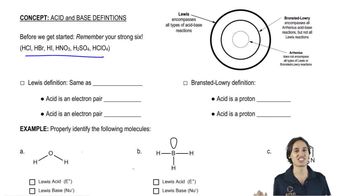
Acid-base reactions involve the transfer of protons (H+) from an acid to a base. In these reactions, acids are proton donors, while bases are proton acceptors. Understanding the strength of the acids and bases involved is crucial, as it influences the direction of the reaction and the stability of the products formed.
Recommended video:
Guided course
02:49
The Lewis definition of acids and bases.

Dissociation of Acids and Bases

Acids and bases dissociate in solution to form ions. For example, acetic acid (CH3COOH) dissociates into acetate ions (CH3COO-) and protons (H+). The extent of dissociation depends on the acid's strength; strong acids dissociate completely, while weak acids only partially dissociate. This concept is essential for predicting the products of the reactions.
Recommended video:
Guided course
02:49
The Lewis definition of acids and bases.

Neutralization Reactions

Neutralization reactions occur when an acid reacts with a base to form water and a salt. In the context of the given question, identifying the products involves recognizing how the acid and base interact, leading to the formation of new compounds. For example, when phthalic acid reacts with NaOH, the result is the formation of a salt and water, illustrating the neutralization process.
Recommended video:
Guided course
05:18
Fukuyama Coupling Reaction