Ch. 19 - Amines
Wade - Organic Chemistry 9th Edition
Wade9th EditionOrganic ChemistryISBN: 9780135213728Not the one you use?Change textbook
Chapter 19, Problem 47c

The two most general amine syntheses are the reductive amination of carbonyl compounds and the reduction of amides. Show how these techniques can be used to accomplish the following syntheses.
(c) pyrrolidine → N-ethylpyrrolidine

Verified step by step guidance
1
Step 1: Begin by identifying the target molecule, N-ethylpyrrolidine, and the starting material, pyrrolidine. The goal is to add an ethyl group to the nitrogen atom of pyrrolidine.
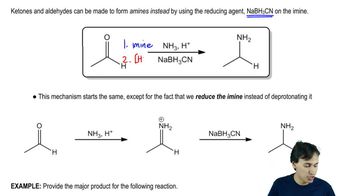
Step 2: Use reductive amination as the synthesis method. In reductive amination, a carbonyl compound (aldehyde or ketone) reacts with an amine to form an imine intermediate, which is then reduced to form the desired amine.
Step 3: Select an appropriate carbonyl compound for the reaction. In this case, ethyl aldehyde (acetaldehyde, CH₃CHO) is a suitable choice because it provides the ethyl group needed for the target molecule.
Step 4: React pyrrolidine with ethyl aldehyde under acidic conditions to form an imine intermediate. The nitrogen atom of pyrrolidine will attack the carbonyl carbon of ethyl aldehyde, leading to the formation of the imine.
Step 5: Reduce the imine intermediate to form N-ethylpyrrolidine. Use a reducing agent such as sodium cyanoborohydride (NaBH₃CN) or hydrogen gas with a metal catalyst (e.g., Pd/C) to complete the synthesis.

Verified video answer for a similar problem:

This video solution was recommended by our tutors as helpful for the problem above.
Video duration:
3m
Was this helpful?

Key Concepts

Here are the essential concepts you must grasp in order to answer the question correctly.

Reductive Amination

Reductive amination is a chemical reaction that involves the conversion of a carbonyl compound (like an aldehyde or ketone) into an amine. This process typically includes the formation of an imine or enamine intermediate, which is then reduced to yield the desired amine. This method is particularly useful for synthesizing secondary and tertiary amines, as it allows for the introduction of alkyl groups onto the nitrogen atom.
Recommended video:
Guided course
07:12
Reductive Amination

Reduction of Amides

The reduction of amides is a process where amides, which are derivatives of carboxylic acids, are converted into amines. This is typically achieved using reducing agents such as lithium aluminum hydride (LiAlH4) or borane (BH3). This method is effective for synthesizing primary amines and can also be used to create secondary and tertiary amines by controlling the reaction conditions and the nature of the starting amide.
Recommended video:
Guided course
01:33
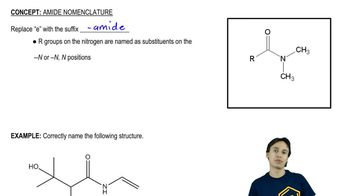
Amide Nomenclature

Pyrrolidine and N-Ethylpyrrolidine

Pyrrolidine is a five-membered saturated heterocyclic compound containing one nitrogen atom. To synthesize N-ethylpyrrolidine, an ethyl group must be introduced to the nitrogen of pyrrolidine. This can be achieved through reductive amination, where an ethyl carbonyl compound (like ethyl acetate) reacts with pyrrolidine, followed by reduction to form the desired N-ethylpyrrolidine.
Recommended video:
3:06
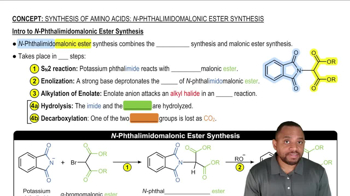
Synthesis of Amino Acids: N-Phthalimidomalonic Ester Synthesis Concept 1
Related Practice
Textbook Question

The two most general amine syntheses are the reductive amination of carbonyl compounds and the reduction of amides. Show how these techniques can be used to accomplish the following syntheses.

(b) benzaldehyde → benzylamine

3
views

Textbook Question

Several additional amine syntheses are effectively limited to making primary amines. The reduction of azides and nitro compounds and the Gabriel synthesis leave the carbon chain unchanged. Formation and reduction of a nitrile adds one carbon atom. Show how these amine syntheses can be used for the following conversions.

(c) 1-bromo-3-phenylheptane → 3-phenylheptan-1-amine

2
views
Textbook Question

Several additional amine syntheses are effectively limited to making primary amines. The reduction of azides and nitro compounds and the Gabriel synthesis leave the carbon chain unchanged. Formation and reduction of a nitrile adds one carbon atom. Show how these amine syntheses can be used for the following conversions.

(a) allyl bromide → allylamine 

2
views
Textbook Question

The two most general amine syntheses are the reductive amination of carbonyl compounds and the reduction of amides. Show how these techniques can be used to accomplish the following syntheses.

(a) benzoic acid → benzylamine

2
views
Textbook Question

The two most general amine syntheses are the reductive amination of carbonyl compounds and the reduction of amides. Show how these techniques can be used to accomplish the following syntheses.

(d) cyclohexanone → N-cyclohexylpyrrolidine

1
views
Textbook Question

Propose mechanisms for the following reactions.

(b)

1
views