Ch. 19 - Amines
Wade - Organic Chemistry 9th Edition
Wade9th EditionOrganic ChemistryISBN: 9780135213728Not the one you use?Change textbook
Chapter 19, Problem 8

The proton and 13C NMR spectra of a compound of formula C4H11N are shown here. Determine the structure of this amine, and give peak assignments for all of the protons in the structure.
<IMAGE>

Verified step by step guidance
1
Step 1: Analyze the molecular formula C4H11N. This indicates the compound is an amine with one nitrogen atom and a total of 11 hydrogens distributed across the structure.
Step 2: Examine the proton (1H) NMR spectrum. The peaks are labeled with integration values: 6H at around 1 ppm, 2H at around 3 ppm, and 1H at around 5 ppm. These integration values correspond to the number of protons contributing to each signal.
Step 3: Interpret the splitting patterns in the proton NMR. The peak at 1 ppm (6H) is likely a singlet, indicating equivalent protons with no neighboring protons. The peak at 3 ppm (2H) may show splitting due to adjacent protons, suggesting a CH2 group. The peak at 5 ppm (1H) is likely a singlet, indicating a proton attached to the nitrogen atom.
Step 4: Examine the 13C NMR spectrum. The spectrum shows two distinct carbon signals, indicating two unique carbon environments. This supports the idea of symmetry in the molecule.
Step 5: Based on the NMR data, propose a structure for the amine. The integration values and splitting patterns suggest the compound is likely isopropylamine (CH3)2CHNH2. Assign the peaks: the 6H signal corresponds to the two CH3 groups, the 2H signal corresponds to the CH group, and the 1H signal corresponds to the NH2 group.

Verified video answer for a similar problem:

This video solution was recommended by our tutors as helpful for the problem above.
Video duration:
6m
Was this helpful?

Key Concepts

Here are the essential concepts you must grasp in order to answer the question correctly.

Nuclear Magnetic Resonance (NMR) Spectroscopy

NMR spectroscopy is a powerful analytical technique used to determine the structure of organic compounds. It relies on the magnetic properties of certain nuclei, such as protons and carbon-13, to provide information about the environment surrounding these nuclei. The resulting spectra reveal chemical shifts, which indicate the electronic environment of the atoms, allowing chemists to deduce structural information about the compound.
Recommended video:
Guided course
10:06
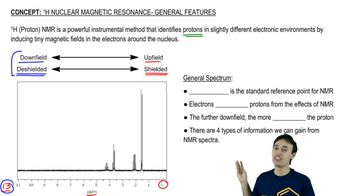
General NMR Features

Chemical Shifts

Chemical shifts in NMR spectroscopy refer to the variation in resonance frequency of a nucleus due to its electronic environment. They are measured in parts per million (ppm) and provide insight into the types of hydrogen or carbon atoms present in a molecule. Understanding chemical shifts is crucial for assigning peaks in the NMR spectrum to specific protons or carbons, which aids in elucidating the compound's structure.
Recommended video:
Guided course
11:44
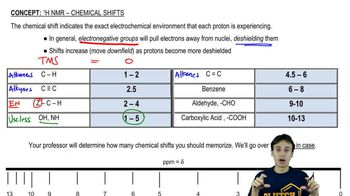
1H NMR Chemical Shifts

Peak Assignments

Peak assignments in NMR involve correlating the observed peaks in the spectrum to specific protons or carbon atoms in the molecular structure. This process requires knowledge of the expected chemical shifts for different functional groups and the splitting patterns that arise from neighboring protons (spin-spin coupling). Accurate peak assignments are essential for constructing a complete and correct structural representation of the compound.
Recommended video:
Guided course
09:26
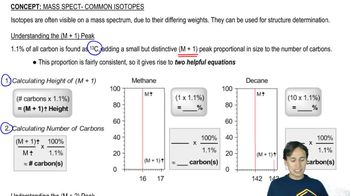
The (M + 1) Peak