
Ch. 19 - Amines
Wade - Organic Chemistry 9th Edition
Wade9th EditionOrganic ChemistryISBN: 9780135213728Not the one you use?Change textbook
Chapter 19, Problem 49b

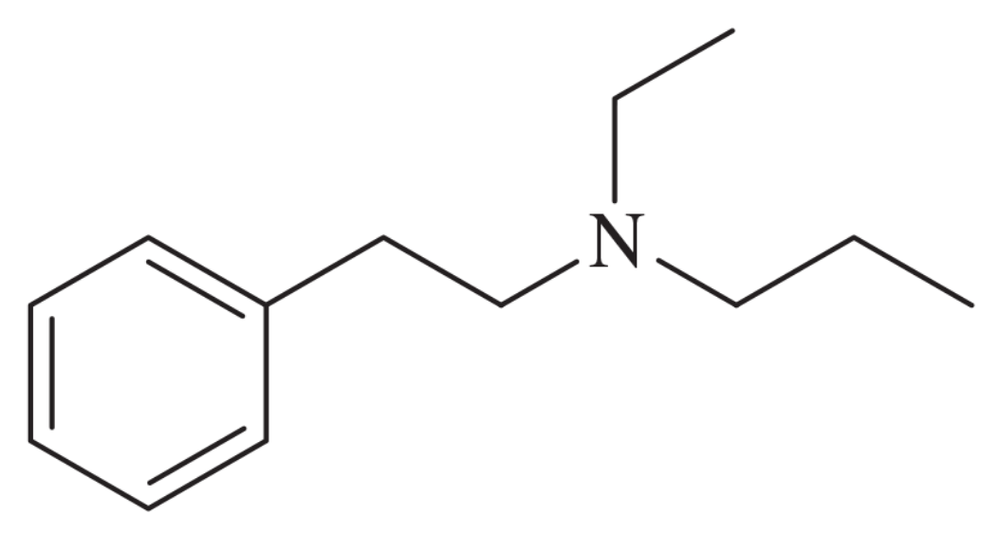
Show how you can synthesize the following tertiary amine three different ways, each using a different secondary amine and adding the final substituent by (b) acylation–reduction (3 ways).

Verified step by step guidance
1
Step 1: Identify the target molecule as a tertiary amine with three substituents: a benzyl group, an ethyl group, and a propyl group. The goal is to synthesize this molecule using acylation-reduction methods with three different secondary amines.
Step 2: First approach: Start with benzylamine (a secondary amine with a benzyl group). Perform acylation by reacting benzylamine with an ethyl acyl chloride (CH3CH2COCl) to form an amide. Then, reduce the amide using a reducing agent like LiAlH4 to yield the tertiary amine with benzyl, ethyl, and propyl substituents.
Step 3: Second approach: Start with ethylamine (a secondary amine with an ethyl group). Perform acylation by reacting ethylamine with benzyl acyl chloride (C6H5CH2COCl) to form an amide. Reduce the amide using LiAlH4 to yield the tertiary amine with benzyl, ethyl, and propyl substituents.
Step 4: Third approach: Start with propylamine (a secondary amine with a propyl group). Perform acylation by reacting propylamine with benzyl acyl chloride (C6H5CH2COCl) to form an amide. Reduce the amide using LiAlH4 to yield the tertiary amine with benzyl, ethyl, and propyl substituents.
Step 5: Ensure that the reaction conditions for acylation and reduction are optimized to prevent overreaction or side reactions. Verify the structure of the final product using spectroscopic methods like NMR or IR to confirm the synthesis of the desired tertiary amine.

Verified video answer for a similar problem:

This video solution was recommended by our tutors as helpful for the problem above.
Video duration:
11m
Was this helpful?

Key Concepts

Here are the essential concepts you must grasp in order to answer the question correctly.

Tertiary Amines

Tertiary amines are organic compounds that contain a nitrogen atom bonded to three carbon-containing groups. They are typically synthesized from secondary amines through various reactions, including acylation followed by reduction. Understanding the structure and reactivity of tertiary amines is crucial for designing synthetic pathways in organic chemistry.
Recommended video:
Guided course
01:57
Naming Secondary and Tertiary Amines

Acylation

Acylation is a chemical reaction that introduces an acyl group (RCO-) into a molecule, often using acyl chlorides or anhydrides. In the context of amines, acylation converts amines into amides, which can then be reduced to form tertiary amines. This step is essential for modifying the amine structure and adding functional groups in synthetic organic chemistry.
Recommended video:
Guided course
05:20
Friedel-Crafts Acylation

Reduction Reactions

Reduction reactions involve the gain of electrons or hydrogen, or the loss of oxygen, resulting in the conversion of a compound to a more saturated form. In the synthesis of tertiary amines, reduction typically follows acylation, where an amide is reduced to a tertiary amine using reducing agents like lithium aluminum hydride (LiAlH4) or catalytic hydrogenation. Understanding reduction mechanisms is vital for successful synthesis.
Recommended video:
Guided course
07:12
Reductive Amination
Related Practice
Textbook Question

Several additional amine syntheses are effectively limited to making primary amines. The reduction of azides and nitro compounds and the Gabriel synthesis leave the carbon chain unchanged. Formation and reduction of a nitrile adds one carbon atom. Show how these amine syntheses can be used for the following conversions.

(c) 1-bromo-3-phenylheptane → 3-phenylheptan-1-amine

2
views
Textbook Question

Several additional amine syntheses are effectively limited to making primary amines. The reduction of azides and nitro compounds and the Gabriel synthesis leave the carbon chain unchanged. Formation and reduction of a nitrile adds one carbon atom. Show how these amine syntheses can be used for the following conversions.

(a) allyl bromide → allylamine 

2
views
Textbook Question

Show how you can synthesize the following compounds starting with benzene, toluene, and alcohols containing no more than four carbon atoms as your organic starting materials. Assume that para is the major product (and separable from ortho) in ortho, para mixtures.

(b) N-methylbutan-1-amine

3
views
Textbook Question

Show how you can synthesize the following compounds starting with benzene, toluene, and alcohols containing no more than four carbon atoms as your organic starting materials. Assume that para is the major product (and separable from ortho) in ortho, para mixtures.

(c) N-ethyl-N-propylbutan-2-amine

1
views
Textbook Question

Show how you can synthesize the following compounds starting with benzene, toluene, and alcohols containing no more than four carbon atoms as your organic starting materials. Assume that para is the major product (and separable from ortho) in ortho, para mixtures.

(a) pentan-1-amine

2
views
Textbook Question

Show how you can synthesize the following tertiary amine three different ways, each using a different secondary amine and adding the final substituent by

(a) reductive amination (3 ways).