Ch. 19 - Amines
Wade - Organic Chemistry 9th Edition
Wade9th EditionOrganic ChemistryISBN: 9780135213728Not the one you use?Change textbook
Chapter 19, Problem 38k

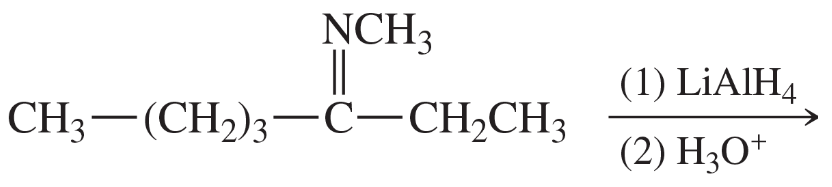
Predict the products of the following reactions:
(k)

Verified step by step guidance
1
Step 1: Identify the functional group in the starting material. The molecule contains a cyclic imine group (C=N) with a methyl substituent attached to the nitrogen atom.
Step 2: Recognize the reagents used in the reaction. Lithium aluminum hydride (LiAlH₄) is a strong reducing agent, and water (H₂O) is used in the second step to quench the reaction.
Step 3: Understand the mechanism of reduction. LiAlH₄ reduces the imine group (C=N) by donating hydride ions (H⁻), converting the imine into an amine (C-NH). The methyl group attached to the nitrogen remains unchanged.
Step 4: Predict the product structure. The cyclic structure remains intact, and the imine group is reduced to a secondary amine (C-NH). The methyl substituent on the nitrogen is preserved.
Step 5: Verify the reaction conditions. Ensure that the reaction proceeds under standard conditions for LiAlH₄ reduction, followed by hydrolysis with water to complete the process and isolate the amine product.

Verified video answer for a similar problem:

This video solution was recommended by our tutors as helpful for the problem above.
Video duration:
1m
Was this helpful?

Key Concepts

Here are the essential concepts you must grasp in order to answer the question correctly.

Reduction Reactions

Reduction reactions involve the gain of electrons or the decrease in oxidation state by a molecule. In organic chemistry, this often pertains to the conversion of functional groups, such as the reduction of carbonyls or nitro groups to alcohols or amines. In this case, lithium aluminum hydride (LiAlH4) acts as a strong reducing agent, capable of reducing various functional groups, including imines and nitriles.
Recommended video:
Guided course
07:12
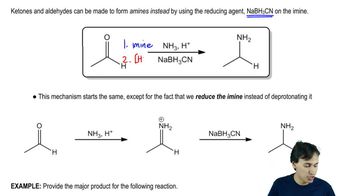
Reductive Amination

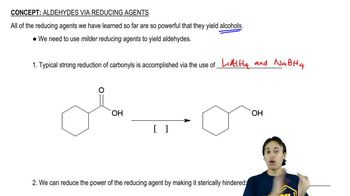
Lithium Aluminum Hydride (LiAlH4)

LiAlH4 is a powerful reducing agent commonly used in organic synthesis. It can reduce a wide range of functional groups, including esters, carboxylic acids, and amines. When reacting with amines, LiAlH4 can convert imines or nitriles into amines, making it essential for understanding the products of the given reaction. The subsequent addition of water (H2O) is crucial for quenching the reaction and hydrolyzing any remaining LiAlH4.
Recommended video:
Guided course
02:07
Why LiAlH4 doesn't work

Hydrolysis

Hydrolysis is a chemical reaction involving the breaking of a bond in a molecule using water. In the context of the reaction with LiAlH4, hydrolysis is necessary to neutralize the reducing agent and convert any intermediate products into stable amines. This step is vital for understanding the final products of the reaction, as it ensures that the reaction mixture is safe and that the desired amine is formed.
Recommended video:
1:00
Hydrolysis of Thioesters Concept 2