Ch. 19 - Amines
Wade - Organic Chemistry 9th Edition
Wade9th EditionOrganic ChemistryISBN: 9780135213728Not the one you use?Change textbook
Chapter 19, Problem 39j

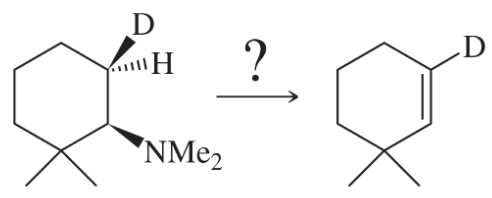
Predict the products of the following reactions:
(j)

Verified step by step guidance
1
Step 1: Analyze the starting material. The given compound is 2-bromopropane, which is a secondary alkyl halide. This will undergo a reaction sequence involving two reagents: trimethylamine ((CH3)3N) and silver oxide (Ag2O) with heat (Δ).
Step 2: Understand the role of trimethylamine ((CH3)3N). Trimethylamine acts as a nucleophile and will likely displace the bromine atom in a nucleophilic substitution reaction, forming an intermediate quaternary ammonium salt.
Step 3: Consider the role of silver oxide (Ag2O) and heat (Δ). Silver oxide in the presence of heat facilitates the Hofmann elimination reaction. This reaction involves the elimination of a β-hydrogen and the leaving group (bromine or the ammonium group), resulting in the formation of an alkene.
Step 4: Determine the regioselectivity of the elimination. The Hofmann elimination typically favors the formation of the less substituted alkene due to steric factors. In this case, the product will likely be propene.
Step 5: Summarize the reaction sequence. The reaction proceeds through nucleophilic substitution to form a quaternary ammonium salt, followed by Hofmann elimination under basic conditions with Ag2O and heat, yielding propene as the final product.

Verified video answer for a similar problem:

This video solution was recommended by our tutors as helpful for the problem above.
Video duration:
6m
Was this helpful?

Key Concepts

Here are the essential concepts you must grasp in order to answer the question correctly.

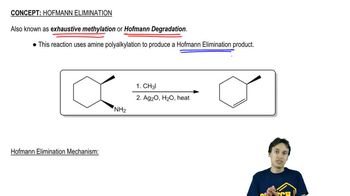
Hofmann Elimination

Hofmann elimination is a reaction that involves the conversion of a quaternary ammonium salt into an alkene through the elimination of a nitrogen-containing leaving group. This process typically requires a strong base and heat, leading to the formation of an alkene and the release of nitrogen gas. Understanding this mechanism is crucial for predicting the products of the given reaction.
Recommended video:
Guided course
03:22
General Reaction

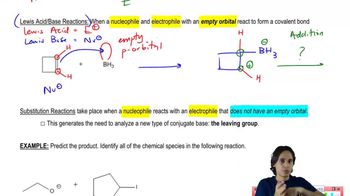
Nucleophilic Substitution

Nucleophilic substitution is a fundamental reaction in organic chemistry where a nucleophile replaces a leaving group in a molecule. In the context of the provided reaction, the tertiary amine (CH3)3N acts as a nucleophile, attacking the carbon atom bonded to the bromine, which is the leaving group. This step is essential for forming the quaternary ammonium salt necessary for the subsequent elimination.
Recommended video:
Guided course
01:47
Nucleophiles and Electrophiles can react in Substitution Reactions.

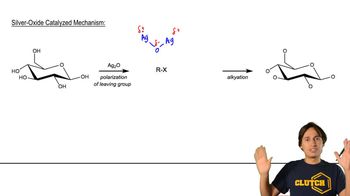
Silver Oxide (Ag2O) in Organic Reactions

Silver oxide (Ag2O) is often used in organic reactions as a mild oxidizing agent or a source of hydroxide ions. In the context of Hofmann elimination, Ag2O can facilitate the deprotonation of the quaternary ammonium salt, promoting the elimination of the nitrogen leaving group and leading to the formation of the alkene. Recognizing the role of Ag2O is important for understanding the reaction conditions and product formation.
Recommended video:
Guided course
03:02
Silver Oxide Catalyzed Mechanism