Ch. 19 - Amines
Wade - Organic Chemistry 9th Edition
Wade9th EditionOrganic ChemistryISBN: 9780135213728Not the one you use?Change textbook
Chapter 19, Problem 25a,b,c

Give the expected products of lithium aluminum hydride reduction of the following compounds (followed by hydrolysis).
(a) butyronitrile
(b) N-cyclohexylacetamide
(c) ε-caprolactam

Verified step by step guidance
1
Identify the functional group in each compound and understand how lithium aluminum hydride (LiAlH₄) reduces it. LiAlH₄ is a strong reducing agent that reduces nitriles, amides, and lactams to their corresponding amines.
For (a) butyronitrile: Recognize that the nitrile group (-C≡N) will be reduced by LiAlH₄ to a primary amine (-CH₂NH₂). Write the reaction: CH₃CH₂CH₂C≡N → CH₃CH₂CH₂CH₂NH₂ after reduction and hydrolysis.
For (b) N-cyclohexylacetamide: Recognize that the amide group (-CONH-) will be reduced by LiAlH₄ to an amine. The carbonyl group (C=O) is removed, and the product will be N-cyclohexylethylamine. Write the reaction: C₆H₁₁NHCOCH₃ → C₆H₁₁NHCH₂CH₃ after reduction and hydrolysis.
For (c) ε-caprolactam: Recognize that the lactam (a cyclic amide) will be reduced by LiAlH₄ to a cyclic amine. The carbonyl group (C=O) in the lactam ring is removed, resulting in hexamethyleneimine. Write the reaction: (CH₂)₅C(O)NH → (CH₂)₅NH after reduction and hydrolysis.
Summarize the products: (a) butylamine (CH₃CH₂CH₂CH₂NH₂), (b) N-cyclohexylethylamine (C₆H₁₁NHCH₂CH₃), and (c) hexamethyleneimine ((CH₂)₅NH). Ensure to understand the role of hydrolysis in completing the reduction process.

Verified video answer for a similar problem:

This video solution was recommended by our tutors as helpful for the problem above.
Video duration:
7m
Was this helpful?

Key Concepts

Here are the essential concepts you must grasp in order to answer the question correctly.

Lithium Aluminum Hydride (LiAlH4) Reduction

Lithium aluminum hydride is a powerful reducing agent commonly used in organic chemistry to reduce various functional groups. It can convert nitriles, amides, and lactams into their corresponding amines by adding hydrogen across the multiple bonds. The reaction typically involves the nucleophilic attack of the hydride ion on the electrophilic carbon of the functional group, followed by hydrolysis to yield the final amine product.
Recommended video:
Guided course
09:12
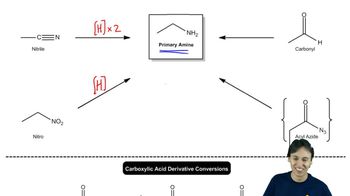
The Primary Amines Flowchart

Hydrolysis

Hydrolysis is a chemical reaction involving the breakdown of a compound due to reaction with water. In the context of LiAlH4 reductions, hydrolysis is crucial as it helps to convert the alkoxide intermediates formed during the reduction into stable alcohols or amines. This step is essential for isolating the final products after the reduction process.
Recommended video:
1:00
Hydrolysis of Thioesters Concept 2

Functional Group Transformation

Functional group transformation refers to the process of converting one functional group into another through chemical reactions. In the case of the compounds mentioned, butyronitrile, N-cyclohexylacetamide, and e-caprolactam, the transformations involve the reduction of nitriles and amides to amines. Understanding the reactivity of these functional groups is key to predicting the products of the reduction reactions.
Recommended video:
Guided course
02:36
Identifying Functional Groups