Ch. 18 - Ketones and Aldehydes
Wade - Organic Chemistry 9th Edition
Wade9th EditionOrganic ChemistryISBN: 9780135213728Not the one you use?Change textbook
Chapter 18, Problem 65d,e,f

Which of the following compounds would give a positive Tollens test? (Remember that the Tollens test involves mild basic aqueous conditions.)
(d) CH3CH2CH2CH2CH(OH)OCH3
(e) CH3CH2CH2CH2CH(OCH3)2
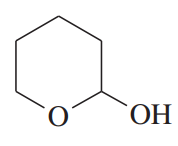
(f) Chemical structure of a cyclic compound with an alcohol (OH) and ether (O) functional group.

Verified step by step guidance
1
Step 1: Recall the purpose of the Tollens test. The Tollens test is used to identify aldehydes. It involves the oxidation of aldehydes to carboxylic acids using a silver-ammonia complex, which results in the formation of a silver mirror. Ketones, alcohols, and ethers do not give a positive Tollens test.
Step 2: Analyze the structure of compound (d) CH3CH2CH2CH2CH(OH)OCH3. This compound contains an ether group (-OCH3) and a secondary alcohol (-CH(OH)-). Neither of these functional groups is an aldehyde, so this compound will not give a positive Tollens test.
Step 3: Analyze the structure of compound (e) CH3CH2CH2CH2CH(OCH3)2. This compound contains two ether groups (-OCH3) attached to the same carbon atom. Again, there is no aldehyde group present, so this compound will not give a positive Tollens test.
Step 4: Analyze the structure of compound (f), shown in the image. The compound is a cyclic structure with a carbonyl group (C=O) and a hydroxyl group (-OH) attached to the same carbon atom. This is a hemiacetal, not an aldehyde. Hemiacetals do not give a positive Tollens test.
Step 5: Conclude that none of the given compounds (d, e, or f) will give a positive Tollens test, as none of them contain an aldehyde functional group.

Verified video answer for a similar problem:

This video solution was recommended by our tutors as helpful for the problem above.
Video duration:
8m
Was this helpful?

Key Concepts

Here are the essential concepts you must grasp in order to answer the question correctly.

Tollens Test

The Tollens test is a qualitative test used to identify aldehydes and certain alpha-hydroxy ketones. It involves the use of Tollens' reagent, which contains silver nitrate in ammonia, and reacts with compounds that can be oxidized to form carboxylic acids. A positive result is indicated by the formation of a silver mirror on the test tube's surface, signifying the reduction of silver ions.
Recommended video:
Guided course
11:40
Q-Test (Proton Relationships)

Aldehydes vs. Ketones

Aldehydes are organic compounds characterized by the presence of a carbonyl group (C=O) at the end of a carbon chain, making them more reactive than ketones, which have the carbonyl group located within the chain. Only aldehydes can typically give a positive Tollens test, as they can be oxidized to carboxylic acids, while ketones generally do not react under these conditions.
Recommended video:
Guided course
03:57
Nucleophilic Addition on Ketones and Aldehydes

Functional Groups

Functional groups are specific groups of atoms within molecules that are responsible for the characteristic chemical reactions of those molecules. In the context of the Tollens test, the presence of an aldehyde functional group (-CHO) is crucial for a positive result, while other groups, such as alcohols or ethers, do not participate in the reaction, highlighting the importance of identifying functional groups in organic compounds.
Recommended video:
Guided course
02:36
Identifying Functional Groups