Ch. 18 - Ketones and Aldehydes
Wade - Organic Chemistry 9th Edition
Wade9th EditionOrganic ChemistryISBN: 9780135213728Not the one you use?Change textbook
Chapter 18, Problem 52a

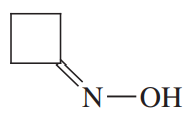
Show how you would synthesize the following derivatives from appropriate carbonyl compounds.
(a) Chemical structure showing a carbonyl compound with an amine derivative, specifically an oxime functional group.

Verified step by step guidance
1
Step 1: Identify the target molecule. The structure provided is a cyclic oxime derivative, specifically a cyclobutanone oxime. Oximes are typically synthesized by reacting a carbonyl compound (ketone or aldehyde) with hydroxylamine (NH2OH).
Step 2: Select the appropriate starting material. Since the target molecule is derived from cyclobutanone, the starting material should be cyclobutanone, which is a four-membered cyclic ketone.
Step 3: Prepare the reagent. Hydroxylamine (NH2OH) is the reagent required for oxime formation. It is typically used in the form of hydroxylamine hydrochloride (NH2OH·HCl) in the presence of a base to neutralize the acidic byproduct.
Step 4: Perform the reaction. Mix cyclobutanone with hydroxylamine in a solvent such as ethanol or water. Add a base like sodium hydroxide (NaOH) or pyridine to facilitate the reaction. The hydroxylamine will attack the carbonyl group of cyclobutanone, forming the oxime derivative.
Step 5: Isolate and purify the product. After the reaction is complete, isolate the cyclobutanone oxime by techniques such as extraction or recrystallization, depending on the solubility of the product in the chosen solvent.

Verified video answer for a similar problem:

This video solution was recommended by our tutors as helpful for the problem above.
Video duration:
2m
Was this helpful?

Key Concepts

Here are the essential concepts you must grasp in order to answer the question correctly.

Carbonyl Compounds

Carbonyl compounds are organic molecules that contain a carbon atom double-bonded to an oxygen atom (C=O). This functional group is pivotal in organic synthesis, as it can undergo various reactions, including nucleophilic addition and condensation. Understanding the reactivity of carbonyls is essential for designing synthetic pathways to derive other compounds.
Recommended video:
Guided course
01:40
Defining meso compounds.

Nucleophilic Addition Reactions

Nucleophilic addition reactions involve the attack of a nucleophile on the electrophilic carbon of a carbonyl group. This reaction is fundamental in organic chemistry, as it allows for the formation of alcohols, amines, and other functional groups from carbonyl compounds. Mastery of this concept is crucial for synthesizing derivatives from carbonyls.
Recommended video:
Guided course
08:27
Nucleophilic Addition

Synthetic Pathways

Synthetic pathways refer to the step-by-step sequences of reactions used to convert starting materials into desired products. In organic synthesis, understanding how to navigate these pathways is vital for efficiently producing target compounds. This includes recognizing the necessary reagents, conditions, and intermediate compounds involved in the transformation of carbonyl derivatives.
Recommended video:
2:13
Energy Production In Biochemical Pathways Concept 1