Ch. 18 - Ketones and Aldehydes
Wade - Organic Chemistry 9th Edition
Wade9th EditionOrganic ChemistryISBN: 9780135213728Not the one you use?Change textbook
Chapter 18, Problem 56c

Show how you would synthesize octanal from each compound. You may use any necessary reagents.
(c) oct-1-yne

Verified step by step guidance
1
Identify the target molecule (octanal) and the starting material (oct-1-yne). Octanal is an aldehyde with the formula CH3(CH2)6CHO, while oct-1-yne is an alkyne with the formula CH≡C-(CH2)5-CH3.
Recognize that the alkyne triple bond in oct-1-yne must be converted into a single bond, and the terminal carbon must be oxidized to form the aldehyde group (-CHO). This suggests a two-step process: (1) partial reduction of the alkyne to an alkene, and (2) hydroboration-oxidation to form the aldehyde.
Perform a partial reduction of the alkyne to a cis-alkene (oct-1-ene) using a reagent like Lindlar's catalyst. This reagent selectively reduces the triple bond to a double bond without further reducing it to a single bond.
Carry out hydroboration-oxidation of the alkene (oct-1-ene) to convert it into the aldehyde (octanal). Use BH3 (borane) or a borane derivative for hydroboration, followed by oxidation with H2O2 (hydrogen peroxide) in a basic solution (e.g., NaOH). This reaction adds the -CHO group to the terminal carbon of the alkene.
Verify the structure of the product to ensure it matches octanal. The hydroboration-oxidation step ensures anti-Markovnikov addition, placing the aldehyde group at the terminal position of the chain.

Verified video answer for a similar problem:

This video solution was recommended by our tutors as helpful for the problem above.
Video duration:
6m
Was this helpful?

Key Concepts

Here are the essential concepts you must grasp in order to answer the question correctly.

Alkyne Reactivity

Alkynes, such as oct-1-yne, are hydrocarbons containing a carbon-carbon triple bond. They are highly reactive and can undergo various reactions, including hydroboration-oxidation and ozonolysis, to form carbonyl compounds. Understanding the reactivity of alkynes is crucial for synthesizing aldehydes like octanal from them.
Recommended video:
Guided course
09:11
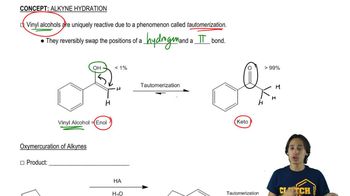
Alkyne Hydration

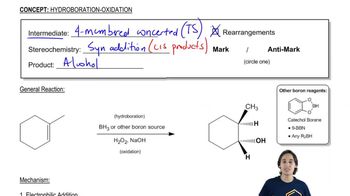
Hydroboration-Oxidation

Hydroboration-oxidation is a two-step reaction that converts alkynes into aldehydes or alcohols. In the first step, the alkyne reacts with diborane (B2H6) to form an organoborane intermediate, which is then oxidized with hydrogen peroxide (H2O2) in the presence of a base to yield the corresponding aldehyde. This method is particularly useful for synthesizing octanal from oct-1-yne.
Recommended video:
Guided course
06:38
General properties of hydroboration-oxidation.

Reagents and Conditions

The choice of reagents and reaction conditions is critical in organic synthesis. For converting oct-1-yne to octanal, specific reagents like diborane for hydroboration and hydrogen peroxide for oxidation must be used. Additionally, controlling reaction conditions such as temperature and pH can influence the yield and selectivity of the desired product.
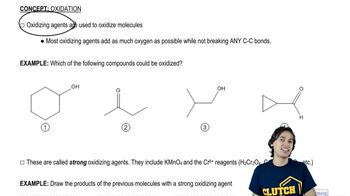
Recommended video: