Ch. 18 - Ketones and Aldehydes
Wade - Organic Chemistry 9th Edition
Wade9th EditionOrganic ChemistryISBN: 9780135213728Not the one you use?Change textbook
Chapter 18, Problem 55b

Show how you would synthesize octan-2-one from each compound. You may use any necessary reagents.
(b) oct-1-yne

Verified step by step guidance
1
Identify the target molecule (octan-2-one) and analyze its structure. It is a ketone with the carbonyl group on the second carbon of an eight-carbon chain. The starting material is oct-1-yne, which is an alkyne with a triple bond between the first and second carbons.
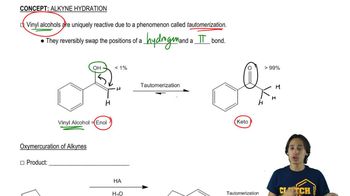
Plan the reaction sequence. To convert an alkyne to a ketone, you can use the hydration of the alkyne. This involves adding water across the triple bond in the presence of specific reagents to form a ketone via keto-enol tautomerism.
Use hydroboration-oxidation to achieve the anti-Markovnikov addition of water to the alkyne. However, since the ketone is required on the second carbon (Markovnikov product), the appropriate method is acid-catalyzed hydration using H₂SO₄ (sulfuric acid), H₂O (water), and HgSO₄ (mercuric sulfate) as a catalyst.
Write the reaction mechanism: The alkyne undergoes electrophilic addition of H⁺ (from H₂SO₄), forming a carbocation intermediate. The addition of water (H₂O) leads to the formation of an enol intermediate. This enol tautomerizes to the more stable ketone form, resulting in octan-2-one.
Verify the product: Ensure that the carbonyl group is on the second carbon of the chain, confirming that the reaction sequence has successfully converted oct-1-yne to octan-2-one.

Verified video answer for a similar problem:

This video solution was recommended by our tutors as helpful for the problem above.
Video duration:
7m
Was this helpful?

Key Concepts

Here are the essential concepts you must grasp in order to answer the question correctly.

Alkyne Reactivity

Alkynes, such as oct-1-yne, are hydrocarbons containing a carbon-carbon triple bond. They are highly reactive and can undergo various reactions, including hydration and hydroboration, to form carbonyl compounds. Understanding the reactivity of alkynes is crucial for synthesizing ketones like octan-2-one, as these reactions can facilitate the transformation of the alkyne into the desired product.
Recommended video:
Guided course
09:11
Alkyne Hydration

Hydration of Alkynes

The hydration of alkynes involves the addition of water across the triple bond, typically in the presence of an acid catalyst. This reaction can yield ketones or aldehydes depending on the structure of the alkyne. For oct-1-yne, the hydration process will lead to the formation of octan-2-one, making it a key step in the synthesis from this compound.
Recommended video:
Guided course
09:11
Alkyne Hydration

Reagents for Synthesis

In organic synthesis, specific reagents are employed to facilitate chemical transformations. For synthesizing octan-2-one from oct-1-yne, reagents such as sulfuric acid (H2SO4) for hydration and possibly a catalyst like mercuric sulfate (HgSO4) may be used. Understanding the role of these reagents is essential for successfully carrying out the synthesis and achieving the desired product.
Recommended video:
1:16
Synthesis of Amino Acids: Strecker Synthesis Example 1