Ch. 18 - Ketones and Aldehydes
Wade - Organic Chemistry 9th Edition
Wade9th EditionOrganic ChemistryISBN: 9780135213728Not the one you use?Change textbook
Chapter 18, Problem 60a

Show how you would accomplish the following syntheses.
(a) benzene → n-butylbenzene

Verified step by step guidance
1
Step 1: Begin with benzene as the starting material. To introduce an alkyl group onto the benzene ring, use the Friedel-Crafts alkylation reaction. This reaction requires an alkyl halide and a Lewis acid catalyst.
Step 2: Select the appropriate alkyl halide for the desired product. In this case, n-butylbenzene requires the introduction of a straight-chain butyl group. Use 1-chlorobutane (CH₃CH₂CH₂CH₂Cl) as the alkyl halide.
Step 3: Use a Lewis acid catalyst, such as aluminum chloride (AlCl₃), to facilitate the Friedel-Crafts alkylation reaction. The catalyst helps generate a carbocation intermediate from the alkyl halide.
Step 4: Perform the reaction by mixing benzene, 1-chlorobutane, and AlCl₃ under controlled conditions. The benzene will act as a nucleophile and attack the carbocation intermediate, forming n-butylbenzene.
Step 5: After the reaction is complete, perform a workup to isolate the product. This typically involves quenching the reaction mixture with water or dilute acid to deactivate the catalyst and then purifying the product using techniques like distillation or recrystallization.

Verified video answer for a similar problem:

This video solution was recommended by our tutors as helpful for the problem above.
Video duration:
8m
Was this helpful?

Key Concepts

Here are the essential concepts you must grasp in order to answer the question correctly.

Electrophilic Aromatic Substitution

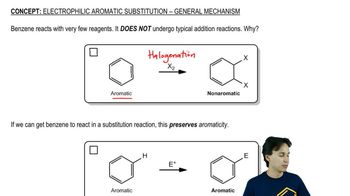
Electrophilic aromatic substitution (EAS) is a fundamental reaction in organic chemistry where an electrophile replaces a hydrogen atom on an aromatic ring. This process is crucial for synthesizing substituted aromatic compounds, such as converting benzene to n-butylbenzene. Understanding the mechanism of EAS, including the formation of the sigma complex and the role of catalysts, is essential for predicting the outcome of such reactions.
Recommended video:

Alkylation of Aromatic Compounds

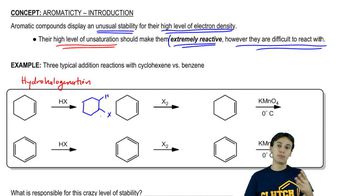
Alkylation involves the introduction of an alkyl group into an aromatic compound, typically through a Friedel-Crafts alkylation reaction. In this process, benzene reacts with an alkyl halide in the presence of a Lewis acid catalyst, such as aluminum chloride, to form the desired alkyl-substituted aromatic compound. Recognizing the conditions and limitations of this reaction is vital for successfully synthesizing n-butylbenzene from benzene.
Recommended video:
Guided course
08:19
Intro to Aromaticity

Rearrangement and Side Reactions

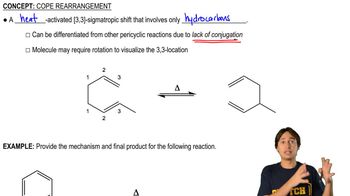
When performing alkylation reactions, it is important to consider potential rearrangements and side reactions that can occur. For example, the carbocation formed during the reaction may rearrange to a more stable structure, leading to different products. Understanding these possibilities helps in predicting the major product and optimizing reaction conditions to favor the desired synthesis of n-butylbenzene.
Recommended video:
Guided course
06:28
Definition of Cope Rearrangement