Ch. 18 - Ketones and Aldehydes
Wade - Organic Chemistry 9th Edition
Wade9th EditionOrganic ChemistryISBN: 9780135213728Not the one you use?Change textbook
Chapter 18, Problem 50d

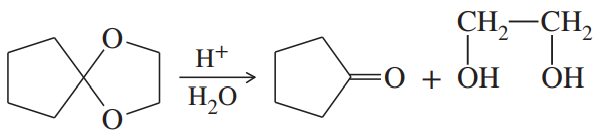
Propose mechanisms for the following reactions.
(d) Chemical reaction diagram illustrating the conversion of a cyclic acetal to a carbonyl compound and alcohols.

Verified step by step guidance
1
Step 1: Analyze the starting material, which is a bicyclic acetal. Acetals are typically hydrolyzed under acidic conditions to yield a carbonyl compound and alcohols.
Step 2: Protonation of one of the oxygen atoms in the acetal occurs first, facilitated by the acidic environment (H⁺). This makes the oxygen more electrophilic and susceptible to nucleophilic attack.
Step 3: Water (H₂O) acts as a nucleophile and attacks the carbon atom bonded to the protonated oxygen, leading to the cleavage of one of the C-O bonds and forming an intermediate hemiacetal.
Step 4: The intermediate hemiacetal undergoes further protonation and hydrolysis, resulting in the formation of a ketone (cyclopentanone) and a diol (ethylene glycol, HOCH₂CH₂OH).
Step 5: The final products are cyclopentanone and ethylene glycol, which are formed after the complete hydrolysis of the acetal under acidic conditions.

Verified video answer for a similar problem:

This video solution was recommended by our tutors as helpful for the problem above.
Video duration:
9m
Was this helpful?

Key Concepts

Here are the essential concepts you must grasp in order to answer the question correctly.

Reaction Mechanisms

A reaction mechanism is a step-by-step description of how a chemical reaction occurs at the molecular level. It outlines the sequence of elementary steps, including bond breaking and formation, and the intermediates formed during the reaction. Understanding mechanisms is crucial for predicting the products and understanding the kinetics and thermodynamics of the reaction.
Recommended video:
Guided course
02:16
Heck Reaction Mechanism

Types of Organic Reactions

Organic reactions can be classified into several types, including substitution, addition, elimination, and rearrangement reactions. Each type has distinct characteristics and mechanisms. Recognizing the type of reaction helps in predicting the behavior of reactants and the nature of the products formed, which is essential for proposing accurate mechanisms.
Recommended video:
Guided course
07:37
Properties and Types of Pericyclic Reactions

Curved Arrow Notation

Curved arrow notation is a visual representation used in organic chemistry to depict the movement of electrons during chemical reactions. Arrows indicate the direction of electron flow, showing how bonds are broken and formed. Mastery of this notation is vital for accurately illustrating reaction mechanisms and understanding the underlying processes in organic reactions.
Recommended video:
Guided course
06:20
Alternative MO Notation for Dienes