Ch. 18 - Ketones and Aldehydes
Wade - Organic Chemistry 9th Edition
Wade9th EditionOrganic ChemistryISBN: 9780135213728Not the one you use?Change textbook
Chapter 18, Problem 41c

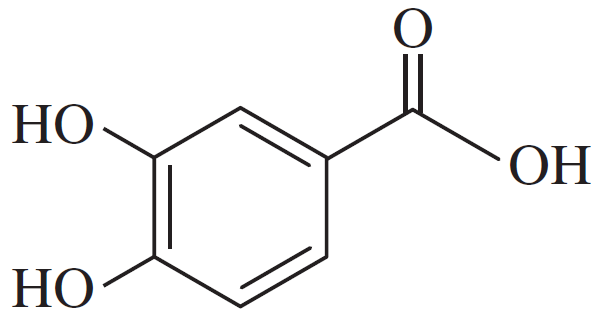
Acetals can serve as protecting groups for 1,2-diols, as well as for aldehydes and ketones. When the acetal is formed from acetone plus the diol, the acetal is called an acetonide. Show the acetonides formed from these diols with acetone under acid catalysis.

Verified step by step guidance
1
Step 1: Identify the functional groups in the given diol structure. The molecule contains two hydroxyl (-OH) groups on the benzene ring, which are 1,2-diols, and a carboxylic acid group (-COOH). The hydroxyl groups are the reactive sites for acetal formation.
Step 2: Understand the reaction mechanism. Under acid catalysis, acetone reacts with 1,2-diols to form acetonides. The reaction involves the nucleophilic attack of the hydroxyl groups on the carbonyl carbon of acetone, followed by the elimination of water.
Step 3: Write the intermediate steps. Protonation of the acetone carbonyl group occurs first, making it more electrophilic. Then, one of the hydroxyl groups attacks the carbonyl carbon, forming a hemiacetal intermediate.
Step 4: Complete the acetal formation. The second hydroxyl group attacks the hemiacetal intermediate, leading to the formation of a cyclic acetal (acetonide). This step involves the loss of a water molecule and results in a stable cyclic structure.
Step 5: Draw the final acetonide structure. The acetonide will be a six-membered ring formed by the two hydroxyl groups and acetone. Ensure the stereochemistry of the cyclic acetal is consistent with the original diol configuration.

Verified video answer for a similar problem:

This video solution was recommended by our tutors as helpful for the problem above.
Video duration:
3m
Was this helpful?

Key Concepts

Here are the essential concepts you must grasp in order to answer the question correctly.

Acetals and Their Formation

Acetals are organic compounds formed when an aldehyde or ketone reacts with an alcohol in the presence of an acid catalyst. This reaction involves the nucleophilic attack of the alcohol on the carbonyl carbon, leading to the formation of a hemiacetal, which can further react with another alcohol molecule to yield a full acetal. Understanding this process is crucial for recognizing how acetals can protect functional groups in organic synthesis.
Recommended video:
Guided course
04:29
Acetal Protecting Group

Protecting Groups in Organic Chemistry

Protecting groups are temporary modifications used to shield reactive functional groups during chemical reactions. In the case of diols, acetals serve as protecting groups by preventing unwanted reactions at the hydroxyl groups. This strategy allows chemists to selectively carry out reactions on other parts of the molecule without interference from the protected functional groups.
Recommended video:
Guided course
02:44
Protecting Groups

Acetonides

Acetonides are specific types of acetals formed when acetone reacts with 1,2-diols. The resulting structure features two alkoxy groups derived from the diol, effectively protecting the hydroxyl functionalities. The formation of acetonides is particularly useful in synthetic organic chemistry, as it allows for the selective manipulation of other functional groups while preserving the integrity of the diol.