Ch. 18 - Ketones and Aldehydes
Wade - Organic Chemistry 9th Edition
Wade9th EditionOrganic ChemistryISBN: 9780135213728Not the one you use?Change textbook
Chapter 18, Problem 21a

2,4-Dinitrophenylhydrazine is frequently used for making derivatives of ketones and aldehydes because the products (2,4-dinitrophenylhydrazones, called 2,4-DNP derivatives) are even more likely than the phenylhydrazones to be solids with sharp melting points. Propose a mechanism for the reaction of acetone with 2,4-dinitrophenylhydrazine in a mildly acidic solution.

Verified step by step guidance
1
Step 1: Protonation of the carbonyl group in acetone. In a mildly acidic solution, the carbonyl oxygen of acetone (CH₃COCH₃) is protonated by a hydronium ion (H₃O⁺), increasing the electrophilicity of the carbonyl carbon. This forms a protonated intermediate, CH₃C(OH⁺)CH₃.
Step 2: Nucleophilic attack by 2,4-dinitrophenylhydrazine. The nucleophilic nitrogen atom of the 2,4-dinitrophenylhydrazine (H₂NNH-C₆H₃(NO₂)₂) attacks the electrophilic carbonyl carbon of the protonated acetone, forming a tetrahedral intermediate.
Step 3: Proton transfer to stabilize the intermediate. A proton is transferred from the nitrogen of the hydrazine group to the hydroxyl group of the intermediate, converting the hydroxyl group into a better leaving group (water). This step prepares the intermediate for the elimination step.
Step 4: Elimination of water. The intermediate undergoes elimination of a water molecule, resulting in the formation of a double bond between the carbon and nitrogen atoms. This forms the imine intermediate, specifically the 2,4-dinitrophenylhydrazone derivative.
Step 5: Resonance stabilization of the product. The final product, 2,4-dinitrophenylhydrazone, is stabilized by resonance due to the electron-withdrawing nitro groups on the aromatic ring, which delocalize the lone pair of electrons on the nitrogen atom, contributing to the stability of the product.

Verified video answer for a similar problem:

This video solution was recommended by our tutors as helpful for the problem above.
Video duration:
8m
Was this helpful?

Key Concepts

Here are the essential concepts you must grasp in order to answer the question correctly.

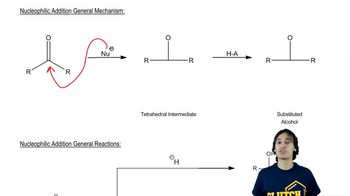
Nucleophilic Addition

Nucleophilic addition is a fundamental reaction mechanism in organic chemistry where a nucleophile attacks an electrophilic carbon atom, typically in carbonyl compounds like aldehydes and ketones. In this context, the nitrogen atom of 2,4-dinitrophenylhydrazine acts as the nucleophile, attacking the electrophilic carbon of acetone's carbonyl group, leading to the formation of a tetrahedral intermediate.
Recommended video:
Guided course
08:27
Nucleophilic Addition

Hydrazone Formation

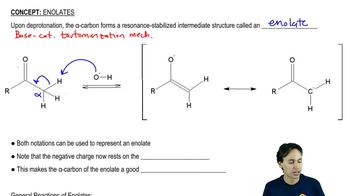
Hydrazone formation is a specific type of condensation reaction where a hydrazine reacts with a carbonyl compound to form a hydrazone. In the case of acetone and 2,4-dinitrophenylhydrazine, the reaction results in the formation of a 2,4-DNP derivative, which is characterized by the loss of water and the formation of a stable C=N bond, contributing to the solid nature of the product.
Recommended video:
Guided course
02:26
Formation of Enolates

Acid-Base Catalysis

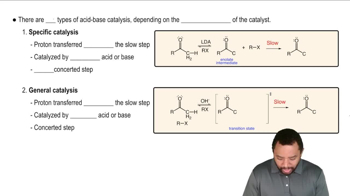
Acid-base catalysis involves the use of an acid to enhance the reactivity of a substrate, often by protonating a functional group to make it a better electrophile. In this reaction, the mildly acidic solution can protonate the carbonyl oxygen of acetone, increasing the electrophilicity of the carbonyl carbon and facilitating the nucleophilic attack by 2,4-dinitrophenylhydrazine.
Recommended video:
2:50
Acid-Base Catalysis Concept 3