
Ch. 17 - Reactions of Aromatic Compounds
Wade - Organic Chemistry 9th Edition
Wade9th EditionOrganic ChemistryISBN: 9780135213728Not the one you use?Change textbook
Chapter 17, Problem 67c

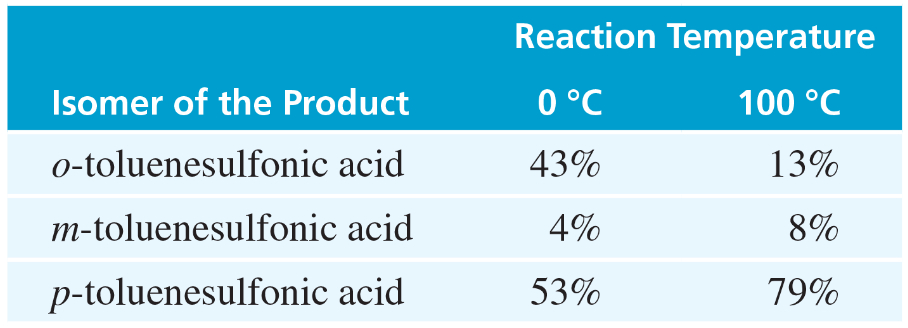
Unlike most other electrophilic aromatic substitutions, sulfonation is often reversible (see Section 17-4). When one sample of toluene is sulfonated at 0 °C and another sample is sulfonated at 100 °C, the following ratios of substitution products result:

c. Because the SO3H group can be added to a benzene ring and removed later, it is sometimes called a blocking group. Show how 2,6-dibromotoluene can be made from toluene using sulfonation and desulfonation as intermediate steps in the synthesis.

Verified step by step guidance
1
Step 1: Begin with toluene as the starting material. Toluene undergoes sulfonation by reacting with concentrated sulfuric acid (H2SO4) and sulfur trioxide (SO3). At 0 °C, the reaction predominantly forms p-toluenesulfonic acid (53%) and o-toluenesulfonic acid (43%), as shown in the table. The para product is favored due to steric hindrance at the ortho position.
Step 2: Use the sulfonation reaction at 0 °C to selectively introduce the SO3H group at the para position of toluene. This step ensures that the para position is blocked, preventing substitution at this site in subsequent reactions.
Step 3: Brominate the molecule using bromine (Br2) in the presence of a catalyst such as FeBr3. Bromination occurs at the ortho positions relative to the methyl group because the para position is blocked by the SO3H group. This results in the formation of 2,6-dibromo-p-toluenesulfonic acid.
Step 4: Remove the SO3H group through desulfonation. Desulfonation is achieved by heating the sulfonated compound in dilute acid (e.g., H2SO4 or HCl). This step regenerates the toluene ring while retaining the bromine substituents at the 2 and 6 positions.
Step 5: The final product is 2,6-dibromotoluene, synthesized through the intermediate steps of sulfonation, bromination, and desulfonation. This method leverages the reversible nature of sulfonation to selectively block and unblock positions on the aromatic ring.

Verified video answer for a similar problem:

This video solution was recommended by our tutors as helpful for the problem above.
Video duration:
9m
Was this helpful?

Key Concepts

Here are the essential concepts you must grasp in order to answer the question correctly.

Electrophilic Aromatic Substitution (EAS)

Electrophilic Aromatic Substitution is a fundamental reaction in organic chemistry where an electrophile replaces a hydrogen atom on an aromatic ring. This process is crucial for synthesizing various aromatic compounds. The reaction typically involves the formation of a sigma complex, where the aromaticity of the ring is temporarily lost, followed by deprotonation to restore aromaticity.
Recommended video:

Reversibility of Sulfonation

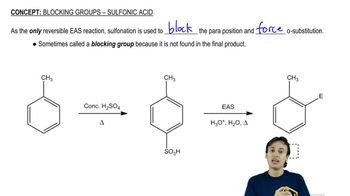
Sulfonation of aromatic compounds, such as toluene, is often reversible, allowing the sulfonic acid group (SO3H) to be added and later removed. This property makes sulfonation a useful synthetic strategy, as the sulfonic group can act as a blocking group, protecting certain positions on the aromatic ring during further reactions. The reversibility is influenced by temperature and the stability of the resulting products.
Recommended video:
Guided course
04:33
Forcing Ortho substitution

Isomer Distribution and Temperature Effects

The distribution of isomers in electrophilic aromatic substitution reactions can be significantly affected by the reaction temperature. In the case of sulfonation, higher temperatures tend to favor the formation of para-substituted products, while lower temperatures can lead to a higher proportion of ortho-substituted products. Understanding this relationship is essential for predicting product outcomes and optimizing reaction conditions.
Recommended video:
Guided course
01:10
What is a constitutional isomer?
Related Practice
Textbook Question

Furan undergoes electrophilic aromatic substitution more readily than benzene; mild reagents and conditions are sufficient. For example, furan reacts with bromine to give 2-bromofuran.

b. Explain why furan undergoes bromination (and other electrophilic aromatic substitutions) primarily at the 2-position.

Textbook Question

In Chapter 14, we saw that Agent Orange contains (2,4,5-trichlorophenoxy) acetic acid, called 2,4,5-T. This compound is synthesized by the partial reaction of 1,2,4,5-tetrachlorobenzene with sodium hydroxide, followed by reaction with sodium chloroacetate, ClCH2CO2Na.

a. Draw the structures of these compounds, and write equations for these reactions.

1
views
Textbook Question

Phenol reacts with three equivalents of bromine in CCl4 (in the dark) to give a product of formula C6H3OBr3. When this product is added to bromine water, a yellow solid of molecular formula C6H2OBr4 precipitates out of the solution. The IR spectrum of the yellow precipitate shows a strong absorption (much like that of a quinone) around 1680 cm–1. Propose structures for the two products.

2
views
Textbook Question

Unlike most other electrophilic aromatic substitutions, sulfonation is often reversible (see Section 17-4). When one sample of toluene is sulfonated at 0 °C and another sample is sulfonated at 100 °C, the following ratios of substitution products result:

a. Explain the change in the product ratios when the temperature is increased.

b. Predict what will happen when the product mixture from the reaction at 0 °C is heated to 100 °C.

1
views
Textbook Question

Starting with benzene and any other reagents you need, show how you would synthesize the compound shown here. (Hint: Consider a Pd-catalyzed coupling for the final step.)

1
views
Textbook Question

(a) Draw the three isomers of benzenedicarboxylic acid.

(b) The isomers have melting points of 210 °C, 343 °C, and 427 °C. Nitration of the isomers at all possible positions was once used to determine their structures. The isomer that melts at 210 °C gives two mononitro isomers. The isomer that melts at 343 °C gives three mononitro isomers. The isomer that melts at 427 °C gives only one mononitro isomer. Show which isomer has which melting point.

1
views