
The bombardier beetle defends itself by spraying a hot quinone solution from its abdomen. This solution is formed by the enzyme-catalyzed oxidation of hydroquinone by hydrogen peroxide. Write a balanced equation for this oxidation.
Ch. 17 - Reactions of Aromatic Compounds
Chapter 17, Problem 41a
Predict the products formed when m-cresol (m-methylphenol) reacts with
(a) NaOH and then ethyl bromide
Verified step by step guidance1
Step 1: Recognize the functional groups in m-cresol (m-methylphenol). It contains a hydroxyl (-OH) group on the benzene ring and a methyl (-CH₃) group in the meta position relative to the hydroxyl group.
Step 2: Understand the role of NaOH in the reaction. NaOH is a strong base that will deprotonate the hydroxyl group of m-cresol, forming the phenoxide ion (C₆H₄(CH₃)-O⁻). This ion is more nucleophilic than the neutral phenol.
Step 3: Analyze the reaction with ethyl bromide (C₂H₅Br). Ethyl bromide is an alkyl halide that can undergo an SN2 reaction with the phenoxide ion. The nucleophilic oxygen of the phenoxide ion will attack the carbon atom of ethyl bromide, displacing the bromide ion (Br⁻) and forming an ether bond.
Step 4: Predict the product of the reaction. The product will be an ether where the ethyl group (C₂H₅) is attached to the oxygen atom of the phenoxide ion, resulting in ethyl m-methylphenyl ether (C₆H₄(CH₃)-O-C₂H₅).
Step 5: Summarize the reaction sequence. The reaction involves two steps: (1) deprotonation of m-cresol by NaOH to form the phenoxide ion, and (2) nucleophilic substitution (SN2) of ethyl bromide by the phenoxide ion to form the ether product.

Verified video answer for a similar problem:
This video solution was recommended by our tutors as helpful for the problem above.
Video duration:
2mWas this helpful?
Key Concepts
Here are the essential concepts you must grasp in order to answer the question correctly.
Nucleophilic Substitution
Nucleophilic substitution is a fundamental reaction mechanism in organic chemistry where a nucleophile replaces a leaving group in a molecule. In the context of the question, the hydroxide ion (OH-) from NaOH acts as a nucleophile, attacking the electrophilic carbon atom of the aromatic ring in m-cresol, leading to the formation of a phenolic compound that can further react with ethyl bromide.
Recommended video:
Guided course
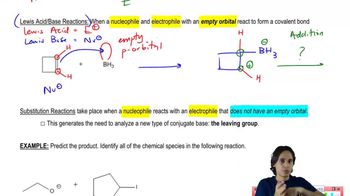
Nucleophiles and Electrophiles can react in Substitution Reactions.
Alkylation of Phenols
Alkylation of phenols involves the introduction of an alkyl group into the aromatic ring through a nucleophilic substitution reaction. When m-cresol reacts with ethyl bromide after being deprotonated by NaOH, the resulting alkoxide ion can attack the ethyl bromide, resulting in the formation of an ether or an alkyl-substituted phenol, depending on the reaction conditions.
Recommended video:
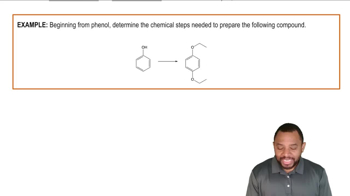
Oxidation of Phenols to Quinones Example 1
Reactivity of Aromatic Compounds
Aromatic compounds, such as m-cresol, exhibit unique reactivity due to their stable resonance structures. The presence of the methyl group in m-cresol activates the aromatic ring towards electrophilic substitution reactions, making it more reactive than non-substituted benzene. Understanding this reactivity is crucial for predicting the products of reactions involving m-cresol and other electrophiles.
Recommended video:
Guided course
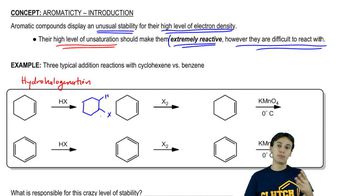
Intro to Aromaticity
Related Practice
Textbook Question
1
views
Textbook Question
1,4-Benzoquinone is a good Diels–Alder dienophile. Predict the products of its reaction with
a. buta-1,3-diene
b. cyclopenta-1,3-diene
1
views
Textbook Question
(c) Based on what you know about the relative stabilities of alkyl radicals and benzylic radicals, predict the product of addition of HBr to 1-phenylpropene in the presence of a free-radical initiator.
(d) Propose a mechanism for this reaction.
1
views
Textbook Question
Show how you would synthesize the following compounds, using the indicated starting materials.
(a) 3-phenylbutan-1-ol from styrene
1
views
Textbook Question
Predict the products formed when m-cresol (m-methylphenol) reacts with
(c) bromine in CCl4 in the dark
1
views
Textbook Question
Predict the products formed when m-cresol (m-methylphenol) reacts with
(b) acetyl chloride,
3
views
