Ch. 17 - Reactions of Aromatic Compounds
Wade - Organic Chemistry 9th Edition
Wade9th EditionOrganic ChemistryISBN: 9780135213728Not the one you use?Change textbook
Chapter 17, Problem 53f

Predict the major products of the following reactions.
(f) p-methylanisole + Br2 , light

Verified step by step guidance
1
Identify the type of reaction: The presence of Br2 and light indicates a free radical halogenation reaction. This reaction typically occurs at the benzylic position (the carbon directly attached to the benzene ring) due to the stability of the benzylic radical intermediate.
Analyze the structure of p-methylanisole: The molecule consists of a benzene ring with two substituents: a methoxy group (-OCH3) at the para position and a methyl group (-CH3) at the other para position.
Determine the reactive site: In free radical halogenation, the benzylic hydrogen (on the methyl group attached to the benzene ring) is the most reactive due to the stability of the benzylic radical formed during the reaction.
Predict the product: The bromine atom will replace one of the benzylic hydrogens on the methyl group, resulting in the formation of p-methoxybenzyl bromide (p-methylanisole with a bromine atom attached to the benzylic carbon).
Consider regioselectivity and side reactions: Since there is only one benzylic position available for substitution, the reaction is regioselective, and the major product will be the brominated derivative at the benzylic position. Minor side reactions, such as over-bromination, are less likely under controlled conditions.

Verified video answer for a similar problem:

This video solution was recommended by our tutors as helpful for the problem above.
Video duration:
2m
Was this helpful?

Key Concepts

Here are the essential concepts you must grasp in order to answer the question correctly.

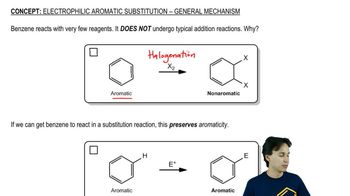
Electrophilic Aromatic Substitution

Electrophilic aromatic substitution (EAS) is a fundamental reaction in organic chemistry where an electrophile replaces a hydrogen atom on an aromatic ring. In the case of p-methylanisole reacting with Br2 in the presence of light, the aromatic ring undergoes substitution, typically at the ortho or para positions relative to the methoxy group, due to its activating and directing effects.
Recommended video:

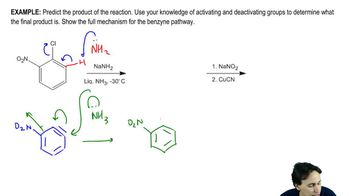
Activating and Deactivating Groups

In EAS reactions, substituents on the aromatic ring can either activate or deactivate the ring towards further substitution. Electron-donating groups, like the methoxy group in p-methylanisole, enhance the electron density of the ring, making it more reactive towards electrophiles. This results in preferential substitution at positions that are ortho or para to the activating group.
Recommended video:
Guided course
03:27
Activating and deactivating groups

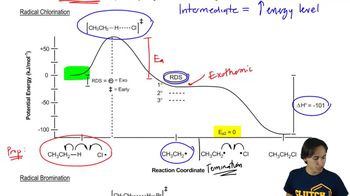
Free Radical Bromination

Free radical bromination is a reaction mechanism that involves the formation of bromine radicals, typically initiated by light or heat. In the presence of light, Br2 can dissociate into two bromine radicals, which can then abstract hydrogen atoms from the aromatic compound, leading to the formation of brominated products. This mechanism is crucial in predicting the products of the reaction involving p-methylanisole and Br2.
Recommended video:
Guided course
05:20
Using the Hammond Postulate to describe radical bromination.