Ch. 17 - Reactions of Aromatic Compounds
Wade - Organic Chemistry 9th Edition
Wade9th EditionOrganic ChemistryISBN: 9780135213728Not the one you use?Change textbook
Chapter 17, Problem 50e

Predict the major products formed when benzene reacts (just once) with the following reagents.
e. isobutylene + HF

Verified step by step guidance
1
Step 1: Recognize the type of reaction. This is an electrophilic aromatic substitution (EAS) reaction, where benzene reacts with an electrophile to form a substituted benzene derivative. In this case, the reagents are isobutylene and HF, which will generate a carbocation electrophile.
Step 2: Understand the role of the reagents. Isobutylene (C(CH3)2=CH2) is an alkene, and HF (hydrofluoric acid) acts as a proton donor. HF will protonate the double bond of isobutylene, forming a tertiary carbocation (C(CH3)3+), which is a highly stable electrophile.
Step 3: Identify the interaction between the carbocation and benzene. The benzene ring, being electron-rich, will act as a nucleophile and attack the tertiary carbocation. This forms a sigma complex (also called an arenium ion), where the benzene ring temporarily loses aromaticity.
Step 4: Restore aromaticity. A proton (H+) is removed from the sigma complex by a base (likely F- from HF), regenerating the aromaticity of the benzene ring. The final product is tert-butylbenzene (C6H5-C(CH3)3), where a tert-butyl group is attached to the benzene ring.
Step 5: Verify the major product. Since the tertiary carbocation is highly stable and benzene undergoes a single substitution, the major product of this reaction is tert-butylbenzene. No further substitution occurs under these conditions.

Verified video answer for a similar problem:

This video solution was recommended by our tutors as helpful for the problem above.
Video duration:
6m
Was this helpful?

Key Concepts

Here are the essential concepts you must grasp in order to answer the question correctly.

Electrophilic Aromatic Substitution

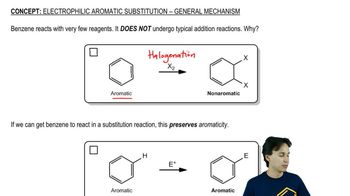
Electrophilic aromatic substitution (EAS) is a fundamental reaction mechanism in organic chemistry where an electrophile replaces a hydrogen atom on an aromatic ring. In this process, the aromatic system donates electrons to the electrophile, forming a sigma complex, which then loses a proton to restore aromaticity. Understanding EAS is crucial for predicting the products of reactions involving benzene and electrophiles.
Recommended video:

Carbocation Stability

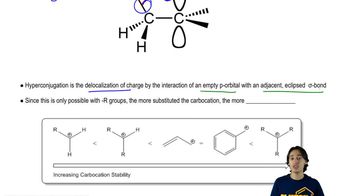
Carbocation stability is a key concept in organic chemistry that refers to the relative stability of positively charged carbon species. Tertiary carbocations are more stable than secondary, which are more stable than primary due to hyperconjugation and inductive effects. In the context of the reaction with isobutylene, the stability of the carbocation formed during the reaction will influence the major product formed.
Recommended video:
Guided course
05:58
Determining Carbocation Stability

Markovnikov's Rule

Markovnikov's Rule states that in the addition of HX to an alkene, the hydrogen atom will attach to the carbon with the greater number of hydrogen atoms already attached, while the halide will attach to the carbon with fewer hydrogen atoms. This principle is important when predicting the products of reactions involving alkenes, such as isobutylene, as it helps determine the regioselectivity of the reaction with benzene.
Recommended video:
Guided course
03:54
The 18 and 16 Electron Rule