Ch. 17 - Reactions of Aromatic Compounds
Wade - Organic Chemistry 9th Edition
Wade9th EditionOrganic ChemistryISBN: 9780135213728Not the one you use?Change textbook
Chapter 17, Problem 50i

Predict the major products formed when benzene reacts (just once) with the following reagents.
(i) iodine + HNO3

Verified step by step guidance
1
Step 1: Recognize the type of reaction. This is an electrophilic aromatic substitution (EAS) reaction, where benzene reacts with iodine (I₂) in the presence of nitric acid (HNO₃) to form a substituted benzene derivative.
Step 2: Understand the role of HNO₃. Nitric acid acts as an oxidizing agent in this reaction, converting iodine (I₂) into the electrophilic species I⁺ (iodonium ion), which is necessary for the substitution reaction.
Step 3: Identify the electrophile. The electrophile in this reaction is the iodonium ion (I⁺), which will attack the benzene ring.
Step 4: Describe the mechanism. The benzene ring donates a pair of π-electrons to the electrophile (I⁺), forming a sigma complex (also called an arenium ion). This intermediate is stabilized by resonance.
Step 5: Regenerate aromaticity. A proton (H⁺) is removed from the sigma complex by a base (often H₂O or NO₃⁻), restoring the aromaticity of the benzene ring and yielding the final product, iodobenzene (C₆H₅I).

Verified video answer for a similar problem:

This video solution was recommended by our tutors as helpful for the problem above.
Video duration:
3m
Was this helpful?

Key Concepts

Here are the essential concepts you must grasp in order to answer the question correctly.

Electrophilic Aromatic Substitution

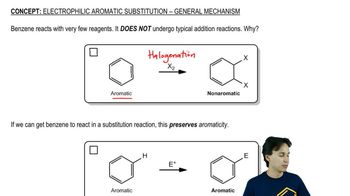
Electrophilic aromatic substitution (EAS) is a fundamental reaction mechanism in organic chemistry where an electrophile replaces a hydrogen atom on an aromatic ring. In this process, the aromatic system retains its stability and aromaticity, which is crucial for understanding how benzene reacts with various reagents. The reaction typically involves the formation of a sigma complex, followed by deprotonation to restore the aromatic character.
Recommended video:

Iodination of Aromatic Compounds

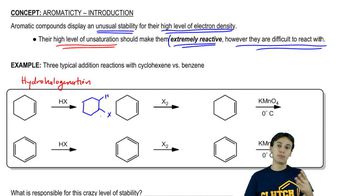
Iodination of aromatic compounds involves the introduction of iodine into the aromatic ring, often facilitated by a Lewis acid catalyst. In the presence of nitric acid (HNO3), iodine can generate an electrophilic species that can react with benzene. This reaction is significant as it demonstrates how halogens can be introduced into aromatic systems, impacting their reactivity and properties.
Recommended video:
Guided course
08:19
Intro to Aromaticity

Nitration and its Role in Electrophilic Reactions

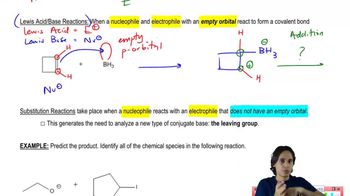
Nitration is the process of introducing a nitro group (-NO2) into an aromatic compound, typically using a mixture of concentrated nitric acid and sulfuric acid. In the context of the given reaction, HNO3 can act as a source of the nitronium ion (NO2+), which is a potent electrophile. Understanding nitration is essential for predicting the products of reactions involving benzene and other electrophiles, as it influences the regioselectivity of subsequent substitutions.
Recommended video:
Guided course
01:47
Nucleophiles and Electrophiles can react in Substitution Reactions.