Ch. 17 - Reactions of Aromatic Compounds
Wade - Organic Chemistry 9th Edition
Wade9th EditionOrganic ChemistryISBN: 9780135213728Not the one you use?Change textbook
Chapter 17, Problem 16c

For each reaction, show the generation of the electrophile and predict the products.
c. tert-butylbenzene + 2-methylpropene + HF

Verified step by step guidance
1
Step 1: Recognize the type of reaction. This is an example of a Friedel-Crafts alkylation reaction, where an alkene (2-methylpropene) reacts with an aromatic compound (tert-butylbenzene) in the presence of an acid catalyst (HF). The reaction involves the generation of a carbocation electrophile from the alkene.
Step 2: Generate the electrophile. The HF acid protonates the alkene (2-methylpropene), leading to the formation of a carbocation. The protonation occurs at the double bond, and the more stable tertiary carbocation is formed. The reaction can be represented as: CH32C=CH2+HFCH3CH3C+.
Step 3: Identify the site of electrophilic attack. The aromatic ring of tert-butylbenzene will act as the nucleophile and attack the carbocation electrophile. The attack occurs at the para position relative to the tert-butyl group, as this position is sterically favorable and electronically stabilized.
Step 4: Form the sigma complex. The attack of the aromatic ring on the carbocation forms a sigma complex (arenium ion), which is an intermediate in the reaction. This intermediate is resonance-stabilized, with the positive charge delocalized over the aromatic ring.
Step 5: Regenerate aromaticity. A proton is lost from the sigma complex, restoring the aromaticity of the ring. The final product is a para-substituted tert-butylbenzene derivative, where the 2-methylpropyl group is attached to the para position of the aromatic ring.

Verified video answer for a similar problem:

This video solution was recommended by our tutors as helpful for the problem above.
Video duration:
2m
Was this helpful?

Key Concepts

Here are the essential concepts you must grasp in order to answer the question correctly.

Electrophiles

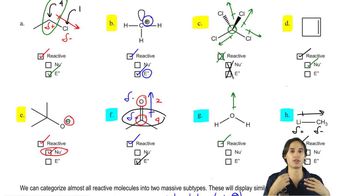
Electrophiles are species that accept electron pairs from nucleophiles during chemical reactions. They are typically positively charged or neutral molecules with an electron-deficient atom, making them reactive towards nucleophiles. In the context of the given reaction, understanding how the electrophile is generated from tert-butylbenzene and HF is crucial for predicting the products.
Recommended video:
Guided course
03:
Nucleophile or Electrophile

Carbocation Stability

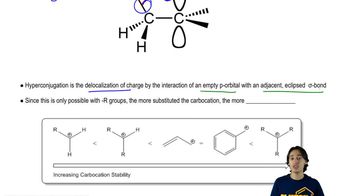
Carbocations are positively charged carbon species that play a key role in many organic reactions. Their stability is influenced by the degree of substitution; tertiary carbocations are more stable than secondary or primary ones due to hyperconjugation and inductive effects. In this reaction, the formation of a stable carbocation from tert-butylbenzene is essential for understanding the subsequent reaction with 2-methylpropene.
Recommended video:
Guided course
05:58
Determining Carbocation Stability

Electrophilic Addition Reactions

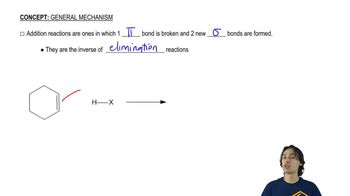
Electrophilic addition reactions involve the addition of an electrophile to a nucleophile, typically across a double bond. In this case, the reaction between the carbocation generated from tert-butylbenzene and 2-methylpropene illustrates this concept. Recognizing the mechanism of electrophilic addition helps in predicting the final products of the reaction.
Recommended video:
Guided course
05:39
Features of Addition Mechanisms.