Show the product of the Diels–Alder dimerization of cyclobutadiene. (This reaction is similar to the dimerization of cyclopentadiene, discussed in Section 15-11.)
Ch. 16 - Aromatic Compounds
Chapter 16, Problem 2c
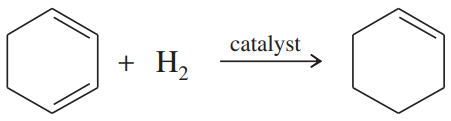
Using the information in Figure 16-2, calculate the values of ∆H° for the following reactions:
(c) 
Verified step by step guidance1
Step 1: Identify the reaction type. The given reaction is a hydrogenation reaction where one double bond in cyclohexene is reduced to form cyclohexane using hydrogen gas and a catalyst.
Step 2: Understand the enthalpy change (∆H°) for hydrogenation reactions. Hydrogenation reactions typically release energy, and the enthalpy change is negative. The value of ∆H° for hydrogenation of one double bond can be found in Figure 16-2 or similar reference data.
Step 3: Locate the ∆H° value for the hydrogenation of a single double bond in the reference figure. This value is specific to the reaction of converting cyclohexene to cyclohexane.
Step 4: Write the balanced chemical equation for the reaction: . This equation represents the addition of hydrogen to cyclohexene.
Step 5: Use the ∆H° value from the reference figure to calculate the enthalpy change for the reaction. Ensure the units are consistent (e.g., kJ/mol) and interpret the negative sign as energy released during the reaction.

Verified video answer for a similar problem:
This video solution was recommended by our tutors as helpful for the problem above.
Video duration:
4mWas this helpful?
Key Concepts
Here are the essential concepts you must grasp in order to answer the question correctly.
Enthalpy Change (∆H°)
Enthalpy change (∆H°) is a measure of the heat content of a system at constant pressure. It indicates whether a reaction is exothermic (releases heat, ∆H° < 0) or endothermic (absorbs heat, ∆H° > 0). Calculating ∆H° for a reaction involves using standard enthalpies of formation for the reactants and products, allowing chemists to predict energy changes during chemical transformations.
Recommended video:
Guided course
Calculating Enthalpies
Catalysis
Catalysis refers to the process of increasing the rate of a chemical reaction by adding a substance known as a catalyst. In the reaction shown, a catalyst facilitates the hydrogenation of benzene to cyclohexane, lowering the activation energy required for the reaction to proceed. Catalysts are not consumed in the reaction, allowing them to be used repeatedly in multiple reaction cycles.
Recommended video:
Nucleophilic Catalysis Concept 1
Hydrogenation
Hydrogenation is a chemical reaction that involves the addition of hydrogen (H₂) to an unsaturated compound, such as an alkene or an aromatic compound. In this case, benzene, an aromatic compound, reacts with hydrogen in the presence of a catalyst to form cyclohexane, a saturated compound. This process is significant in organic chemistry for converting unsaturated hydrocarbons into more stable saturated forms.
Recommended video:
Guided course
The definition of hydrogenation.
Related Practice
Textbook Question
1
views
Textbook Question
a. Draw the resonance forms of benzene, cyclobutadiene, and cyclooctatetraene, showing all the carbon and hydrogen atoms.
b. Assuming that these molecules are all planar, show how the p orbitals on the sp2 hybrid carbon atoms form continuous rings of overlapping orbitals above and below the plane of the carbon atoms.
10
views
Textbook Question
Using the information in Figure 16-2, calculate the values of ∆H° for the following reactions:
(b)
11
views
Textbook Question
Does the MO energy diagram of cyclooctatetraene (Figure 16-8) appear to be a particularly stable or unstable configuration? Explain.
1
views
Textbook Question
Using the information in Figure 16-2, calculate the values of ∆H° for the following reactions:
(a)
1
views