Ch. 16 - Aromatic Compounds
Wade - Organic Chemistry 9th Edition
Wade9th EditionOrganic ChemistryISBN: 9780135213728Not the one you use?Change textbook
Chapter 16, Problem 29d

Four pairs of compounds are shown. In each pair, one of the compounds reacts more quickly, or with a more favorable equilibrium constant, than the less conjugated system. In each case, explain the enhanced reactivity.
(d) Chemical structures comparing acidity, showing one compound with hydroxyl and carbonyl groups is more acidic than another.

Verified step by step guidance
1
Step 1: Analyze the structures of the two compounds. The first compound is a hydroxybenzoquinone derivative, which contains two carbonyl groups adjacent to the hydroxyl group. The second compound is phenol, which has a hydroxyl group attached to a benzene ring.
Step 2: Consider the acidity of the hydroxyl group in both compounds. Acidity is influenced by the ability of the conjugate base to stabilize the negative charge after deprotonation. In the first compound, the conjugate base is stabilized by resonance with the two adjacent carbonyl groups.
Step 3: Explain the resonance stabilization in the first compound. After deprotonation of the hydroxyl group, the negative charge on the oxygen can delocalize into the aromatic ring and further onto the carbonyl groups. This extensive delocalization significantly stabilizes the conjugate base.
Step 4: Compare this to phenol. In phenol, the negative charge on the oxygen after deprotonation can only delocalize into the aromatic ring, which provides less stabilization compared to the first compound.
Step 5: Conclude that the enhanced resonance stabilization in the first compound due to the presence of the carbonyl groups makes it more acidic than phenol.

Verified video answer for a similar problem:

This video solution was recommended by our tutors as helpful for the problem above.
Video duration:
5m
Was this helpful?

Key Concepts

Here are the essential concepts you must grasp in order to answer the question correctly.

Acidity and pKa

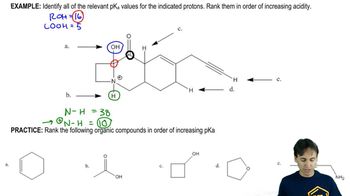
Acidity in organic chemistry refers to the ability of a compound to donate a proton (H+). The strength of an acid is often measured by its pKa value; lower pKa values indicate stronger acids. In the context of the compounds shown, the one with the lower pKa is more acidic, meaning it can more readily lose a proton compared to the other compound.
Recommended video:
Guided course
07:45
Identifying pKa values

Resonance Stabilization

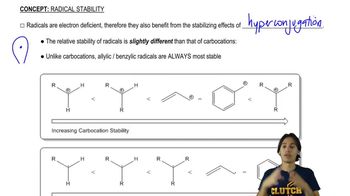
Resonance stabilization occurs when a molecule can be represented by multiple valid Lewis structures, allowing for the delocalization of electrons. In the more acidic compound, the negative charge on the conjugate base can be delocalized over multiple electronegative atoms, which stabilizes the anion formed after deprotonation, thus enhancing acidity.
Recommended video:
Guided course
03:43
The radical stability trend.

Inductive Effect

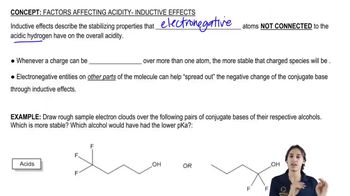
The inductive effect refers to the electron-withdrawing or electron-donating effects of substituents in a molecule, which can influence acidity. Electron-withdrawing groups, such as carbonyls or nitro groups, can stabilize the negative charge on the conjugate base, making the acid more likely to donate a proton. This effect is significant in comparing the acidity of the two compounds shown.
Recommended video:
Guided course
01:47
Understanding the Inductive Effect.