Ch. 15 - Conjugated Systems, Orbital Symmetry, and Ultraviolet Spectroscopy
Wade - Organic Chemistry 9th Edition
Wade9th EditionOrganic ChemistryISBN: 9780135213728Not the one you use?Change textbook
Chapter 15, Problem 13a

Show how you might synthesize the following compounds starting with bromobenzene, and alkyl or alkenyl halides of four carbon atoms or fewer.
a. 3-phenylprop-1-ene

Verified step by step guidance
1
Step 1: Begin with bromobenzene (C6H5Br) as the starting material. Perform a Grignard reaction by reacting bromobenzene with magnesium (Mg) in dry ether to form phenylmagnesium bromide (C6H5MgBr). This is a key organometallic intermediate.
Step 2: Prepare propenal (CH2=CH-CHO), which is an alkenyl compound with three carbon atoms. This can be synthesized separately if not readily available.
Step 3: Perform a nucleophilic addition reaction between phenylmagnesium bromide (C6H5MgBr) and propenal (CH2=CH-CHO). The Grignard reagent will attack the carbonyl carbon of propenal, forming an intermediate alcohol.
Step 4: Dehydrate the intermediate alcohol to form 3-phenylprop-1-ene (C6H5-CH=CH-CH2). This can be achieved using an acid catalyst, such as concentrated sulfuric acid (H2SO4), to remove water and form the double bond.
Step 5: Purify the product using distillation or another appropriate method to isolate 3-phenylprop-1-ene. Confirm the structure using spectroscopic techniques such as NMR or IR.

Verified video answer for a similar problem:

This video solution was recommended by our tutors as helpful for the problem above.
Video duration:
5m
Was this helpful?

Key Concepts

Here are the essential concepts you must grasp in order to answer the question correctly.

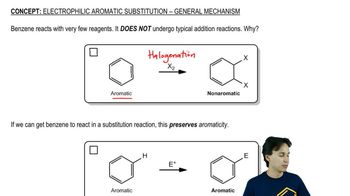
Electrophilic Aromatic Substitution

Electrophilic aromatic substitution (EAS) is a fundamental reaction in organic chemistry where an electrophile replaces a hydrogen atom on an aromatic ring. In the context of synthesizing 3-phenylprop-1-ene from bromobenzene, EAS can be used to introduce a propyl group onto the benzene ring, forming a substituted aromatic compound that can further undergo elimination to yield the desired alkene.
Recommended video:

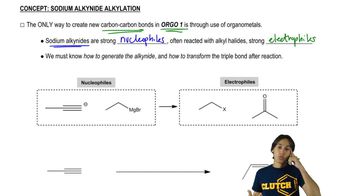
Alkylation Reactions

Alkylation reactions involve the introduction of an alkyl group into a molecule, often through nucleophilic substitution or EAS. In this synthesis, alkyl halides can react with bromobenzene to form a new carbon-carbon bond, which is crucial for building the propyl chain needed for 3-phenylprop-1-ene. Understanding the reactivity of alkyl halides is essential for selecting the appropriate reaction conditions.
Recommended video:
Guided course
03:19
Sodium Alkynide Alkylation

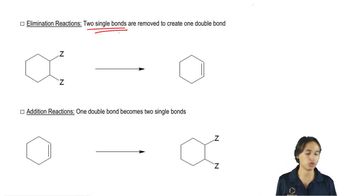
Elimination Reactions

Elimination reactions are processes where elements of the starting material are removed, resulting in the formation of a double bond. In synthesizing 3-phenylprop-1-ene, after the alkylation step, an elimination reaction can be performed to remove a leaving group and generate the alkene. This step is vital for achieving the final product with the desired double bond configuration.
Recommended video:
Guided course
00:40
Recognizing Elimination Reactions.
Related Practice
Textbook Question

Show how you might synthesize the following compounds starting with bromobenzene, and alkyl or alkenyl halides of four carbon atoms or fewer.

c. dec-5-ene

1
views

Textbook Question

When Br2 is added to buta-1,3-diene at –15 °C, the product mixture contains 60% of product A and 40% of product B. When the same reaction takes place at 60 °C, the product ratio is 10% A and 90% B.

d. If you had a solution of pure A, and its temperature were raised to 60 °C, what would you expect to happen? Propose a mechanism to support your prediction.

2
views
Textbook Question

Predict the products of the following proposed Diels–Alder reactions.

(a)

1
views
Textbook Question

Show how you might synthesize the following compounds starting with bromobenzene, and alkyl or alkenyl halides of four carbon atoms or fewer.

b. 5-methylhex-2-ene

Textbook Question

When N-bromosuccinimide is added to hex-1-ene in CCl4 and a sunlamp is shone on the mixture, three products result.

(a) Give the structures of these three products.

(b) Propose a mechanism that accounts for the formation of these three products

1
views
Textbook Question

Addition of 1-bromobut-2-ene to magnesium metal in dry ether results in formation of a Grignard reagent. Addition of water to this Grignard reagent gives a mixture of but-1-ene and but-2-ene (cis and trans). When the Grignard reagent is made using 3-bromobut-1-ene, addition of water produces exactly the same mixture of products in the same ratios. Explain this curious result

1
views