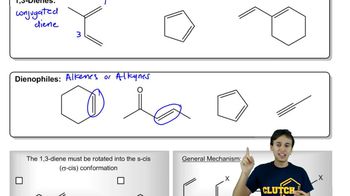
Show that the [4 + 2] Diels–Alder reaction is photochemically forbidden.
Ch. 15 - Conjugated Systems, Orbital Symmetry, and Ultraviolet Spectroscopy
All textbooks
Wade 9th Edition
Ch. 15 - Conjugated Systems, Orbital Symmetry, and Ultraviolet Spectroscopy
Problem 18c,d
Wade 9th Edition
Ch. 15 - Conjugated Systems, Orbital Symmetry, and Ultraviolet Spectroscopy
Problem 18c,dChapter 15, Problem 18c,d
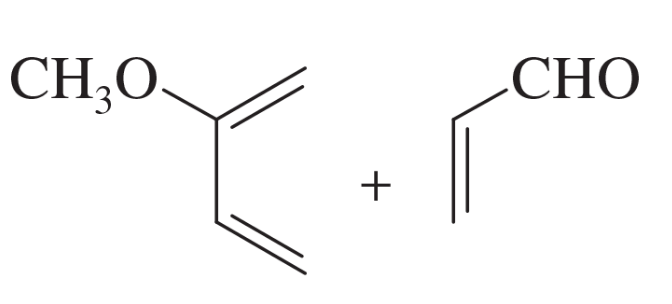
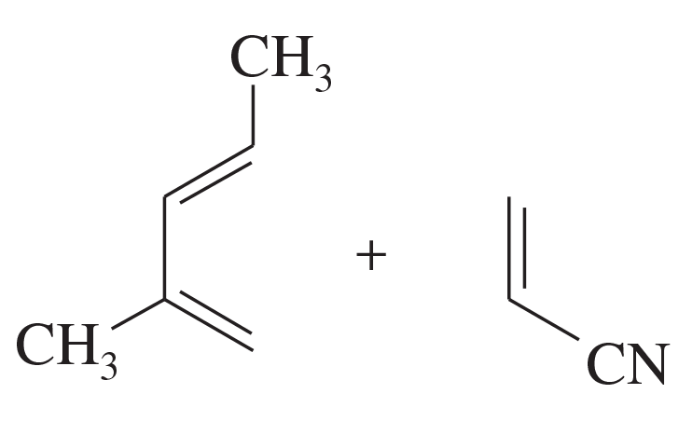
Predict the products of the following Diels–Alder reactions.
(c) 
(d) 
Verified step by step guidance1
Step 1: Identify the diene and dienophile in each reaction. In the first image, the diene is the compound with the CH3O group and two conjugated double bonds, while the dienophile is the compound with the CHO group and a single double bond. In the second image, the diene is the compound with two conjugated double bonds and CH3 groups, while the dienophile is the compound with the CN group and a single double bond.
Step 2: Recall the Diels–Alder reaction mechanism. It is a [4+2] cycloaddition reaction where the diene contributes four π-electrons and the dienophile contributes two π-electrons to form a six-membered ring.
Step 3: Analyze the electron-withdrawing groups (EWGs) on the dienophile. In the first reaction, the CHO group is an EWG, which enhances the reactivity of the dienophile. In the second reaction, the CN group is an EWG, which also enhances the reactivity of the dienophile.
Step 4: Predict the regiochemistry of the reaction. The electron-donating group (CH3O) on the diene will direct the reaction to form the most stable product. Similarly, the CH3 groups on the diene in the second reaction will influence the regioselectivity of the product.
Step 5: Draw the product structure. Combine the diene and dienophile to form a six-membered ring. Ensure that the substituents (CH3O, CHO, CH3, CN) are correctly positioned based on the regioselectivity and stereochemistry of the reaction.

Verified video answer for a similar problem:
This video solution was recommended by our tutors as helpful for the problem above.
Video duration:
6mWas this helpful?
Key Concepts
Here are the essential concepts you must grasp in order to answer the question correctly.
Diels–Alder Reaction
The Diels–Alder reaction is a [4+2] cycloaddition reaction between a conjugated diene and a dienophile, resulting in the formation of a six-membered ring. This reaction is a key method in organic synthesis for constructing cyclic compounds and is characterized by its stereospecificity and regioselectivity, making it a powerful tool for chemists.
Recommended video:
Guided course
Diels-Alder Retrosynthesis
Conjugated Dienes
Conjugated dienes are compounds that contain two double bonds separated by a single bond, allowing for resonance stabilization. This structure enhances their reactivity in Diels–Alder reactions, as the electron-rich diene can effectively interact with the electron-deficient dienophile, facilitating the formation of new bonds during the reaction.
Recommended video:
Guided course
Conjugated states
Dienophile
A dienophile is a compound that contains a double or triple bond and reacts with a diene in a Diels–Alder reaction. Typically, dienophiles are electron-deficient, which makes them more reactive towards the electron-rich diene. Common examples include alkenes and alkynes with electron-withdrawing groups, which enhance their reactivity in cycloaddition reactions.
Recommended video:
Guided course
General Features
Related Practice
Textbook Question
5
views
Textbook Question
We predicted that the products would have a 1,2- or 1,4-relationship of the proper substituents. Draw the charge-separated resonance forms of the reactants to support these predictions.
(a) (b)
5
views
Textbook Question
Show that the [4 + 4] cycloaddition of two butadiene molecules to give cycloocta-1,5-diene is thermally forbidden but photochemically allowed.
2
views
Textbook Question
There is a different, thermally allowed cycloaddition of two butadiene molecules. Show this reaction, and explain why it is thermally allowed. (Hint: Consider the dimerization of cyclopentadiene.)
8
views
Textbook Question
Predict the major product for each proposed Diels–Alder reaction. Include stereochemistry where appropriate.
(a)
1
views
Textbook Question
Predict the products of the following Diels–Alder reactions.
(a)
(b)
1
views