Ch. 15 - Conjugated Systems, Orbital Symmetry, and Ultraviolet Spectroscopy
Wade - Organic Chemistry 9th Edition
Wade9th EditionOrganic ChemistryISBN: 9780135213728Not the one you use?Change textbook
Chapter 15, Problem 34a

Give the structures of the products represented by letters in this synthesis.
Part 1:

Verified step by step guidance
1
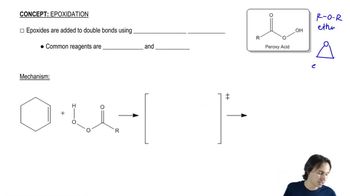
Step 1: The first reaction involves the use of mCPBA (meta-chloroperoxybenzoic acid), which is a reagent for epoxidation. The double bond in cyclohexene reacts with mCPBA to form an epoxide (A). This is a three-membered cyclic ether structure.
Step 2: The epoxide (A) undergoes ring-opening in the presence of NaOH and H2O. This reaction leads to the formation of a diol (B), where two hydroxyl groups are added to the positions previously occupied by the double bond.
Step 3: The diol (B) is then treated with excess NaOCl (sodium hypochlorite) in the presence of HOAc (acetic acid). This oxidative cleavage reaction converts the diol into a ketone (C). Specifically, one of the hydroxyl groups is oxidized to form a carbonyl group.
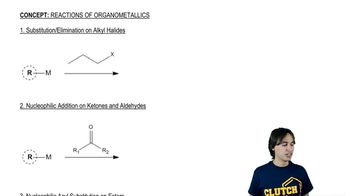
Step 4: The ketone (C) reacts with CH3MgBr (methylmagnesium bromide, a Grignard reagent) in ether. This reaction forms a tertiary alcohol (D) after the addition of the methyl group to the carbonyl carbon and subsequent protonation with H3O+.
Step 5: The tertiary alcohol (D) undergoes dehydration in the presence of H2SO4 and heat. This elimination reaction forms an alkene (E), which is a mixture of diastereomers with the molecular formula C8H12.

Verified video answer for a similar problem:

This video solution was recommended by our tutors as helpful for the problem above.
Video duration:
8m
Was this helpful?

Key Concepts

Here are the essential concepts you must grasp in order to answer the question correctly.

Epoxidation

Epoxidation is a reaction that converts alkenes into epoxides, which are three-membered cyclic ethers. In this synthesis, mCPBA (meta-chloroperbenzoic acid) is used as the oxidizing agent to form an epoxide from the benzene derivative. Understanding this step is crucial as it sets the stage for subsequent reactions in the synthesis.
Recommended video:
Guided course
02:19
General properties of epoxidation.

Grignard Reaction

The Grignard reaction involves the addition of a Grignard reagent, such as CH3MgBr, to a carbonyl compound, leading to the formation of alcohols. In this synthesis, the Grignard reagent reacts with the epoxide to open the ring and form a new carbon-carbon bond, which is essential for building the desired product structure.
Recommended video:
Guided course
13:40
Reactions of Organometallics

Stereochemistry and Diastereomers

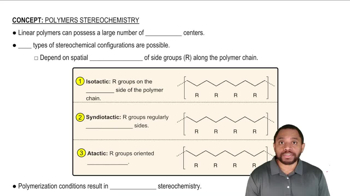
Stereochemistry is the study of the spatial arrangement of atoms in molecules, which affects their properties and reactivity. The synthesis results in a mixture of diastereomers, which are stereoisomers that are not mirror images of each other. Recognizing the formation of diastereomers is important for understanding the final product's characteristics and potential applications.
Recommended video:
1:38
Polymer Stereochemistry Concept 1