Ch. 14 - Ethers, Epoxides, and Thioethers
Wade - Organic Chemistry 9th Edition
Wade9th EditionOrganic ChemistryISBN: 9780135213728Not the one you use?Change textbook
Chapter 14, Problem 45c

Show how you would synthesize the following ethers in good yield from the indicated starting materials and any additional reagents needed.
(c) 2-ethoxyoctane from an octene

Verified step by step guidance
1
Step 1: Recognize that the target molecule, 2-ethoxyoctane, is an ether. Ethers can be synthesized using the Williamson ether synthesis, which involves the reaction of an alkoxide ion with an alkyl halide.
Step 2: Analyze the starting material, octene. Octene is an alkene, so it must first be converted into a suitable intermediate. Perform an acid-catalyzed hydration of octene to form 2-octanol. This reaction involves the addition of water across the double bond in the presence of an acid catalyst.
Step 3: Convert 2-octanol into 2-octyl bromide (or another suitable alkyl halide) using a reagent like phosphorus tribromide (PBr₃) or thionyl chloride (SOCl₂). This step transforms the alcohol group into a good leaving group, making it reactive for the next step.
Step 4: Prepare the ethoxide ion (C₂H₅O⁻) by reacting ethanol (C₂H₅OH) with a strong base such as sodium hydride (NaH) or sodium metal (Na). This generates the nucleophilic ethoxide ion needed for the Williamson ether synthesis.
Step 5: React the 2-octyl bromide with the ethoxide ion in an SN2 reaction. The ethoxide ion will attack the carbon attached to the bromine, displacing the bromide ion and forming 2-ethoxyoctane as the final product.

Verified video answer for a similar problem:

This video solution was recommended by our tutors as helpful for the problem above.
Video duration:
3m
Was this helpful?

Key Concepts

Here are the essential concepts you must grasp in order to answer the question correctly.

Ethers and Their Synthesis

Ethers are organic compounds characterized by an oxygen atom connected to two alkyl or aryl groups. Their synthesis often involves the reaction of alcohols or alkoxides with alkyl halides through nucleophilic substitution. Understanding the mechanisms of ether formation is crucial for designing synthetic pathways, especially when aiming for specific yields and purity.
Recommended video:
Guided course
03:50
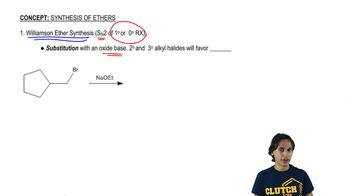
The Mechanism of Williamson Ether Synthesis.

Nucleophilic Substitution Reactions

Nucleophilic substitution reactions, such as SN2 and SN1, are fundamental in organic chemistry for forming new bonds. In the context of ether synthesis, a strong nucleophile (like an alkoxide) attacks an electrophilic carbon in an alkyl halide, leading to the formation of the ether. The choice between SN2 and SN1 mechanisms depends on the structure of the substrate and the reaction conditions.
Recommended video:
Guided course
01:47
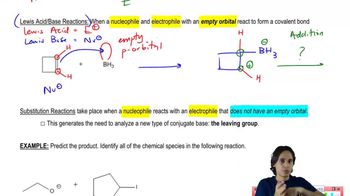
Nucleophiles and Electrophiles can react in Substitution Reactions.

Alkenes and Their Functionalization

Alkenes are hydrocarbons with at least one carbon-carbon double bond and serve as versatile intermediates in organic synthesis. They can be functionalized through various reactions, such as hydroboration-oxidation or alkylation, to introduce new functional groups. In synthesizing ethers from alkenes, understanding how to convert the double bond into a suitable leaving group is essential for successful ether formation.
Recommended video:
Guided course
02:36
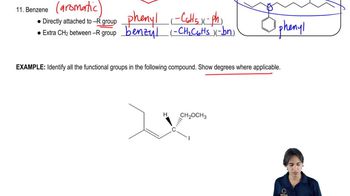
Identifying Functional Groups