
Ch. 14 - Ethers, Epoxides, and Thioethers
Wade - Organic Chemistry 9th Edition
Wade9th EditionOrganic ChemistryISBN: 9780135213728Not the one you use?Change textbook
Chapter 14, Problem 15d

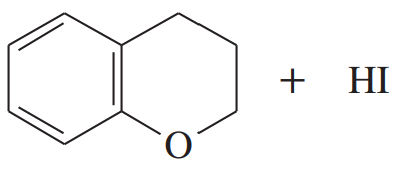
Predict the products of the following reactions. An excess of acid is available in each case.
(d) Chemical structure of an ether reacting with hydroiodic acid (HI) to illustrate ether cleavage.

Verified step by step guidance
1
Step 1: Analyze the structure of the reactant. The reactant is a cyclic ether (specifically, a benzopyran structure) with an oxygen atom in a six-membered ring fused to a benzene ring.
Step 2: Recognize the role of HI (hydroiodic acid) in the reaction. HI is a strong acid and a source of iodide ions (I⁻). It can protonate the oxygen atom in the ether, making it susceptible to cleavage.
Step 3: Protonation of the oxygen atom occurs first. The lone pair of electrons on the oxygen atom interacts with the hydrogen ion (H⁺) from HI, forming a positively charged oxonium ion.
Step 4: The bond between the oxygen atom and one of the adjacent carbon atoms breaks, leading to the formation of two products. The iodide ion (I⁻) attacks the positively charged carbon atom, resulting in the formation of an alkyl iodide.
Step 5: The other product formed is a phenol group (benzene ring with an -OH group attached) due to the cleavage of the ether bond. The final products are phenol and an alkyl iodide.

Verified video answer for a similar problem:

This video solution was recommended by our tutors as helpful for the problem above.
Video duration:
4m
Was this helpful?

Key Concepts

Here are the essential concepts you must grasp in order to answer the question correctly.

Acid-Base Reactions

Acid-base reactions involve the transfer of protons (H+) between reactants. In organic chemistry, acids can donate protons, while bases accept them. Understanding the role of acids in promoting reactions, especially in the presence of excess acid, is crucial for predicting the products formed in various organic transformations.
Recommended video:
Guided course
02:49
The Lewis definition of acids and bases.

Reaction Mechanisms

A reaction mechanism outlines the step-by-step process by which reactants convert into products. It includes the formation and breaking of bonds, intermediates, and transition states. Familiarity with common mechanisms, such as nucleophilic substitution or electrophilic addition, is essential for predicting the outcome of reactions, especially when excess reagents are involved.
Recommended video:
Guided course
02:16
Heck Reaction Mechanism

Functional Group Transformations

Functional groups are specific groups of atoms within molecules that determine their chemical reactivity. In organic reactions, the presence of certain functional groups can dictate the type of reaction that occurs. Recognizing how excess acid can affect functional groups, such as converting alcohols to alkyl halides or facilitating esterification, is vital for predicting reaction products.
Recommended video:
Guided course
02:36
Identifying Functional Groups
Related Practice
Textbook Question

Boron tribromide (BBr3) cleaves ethers to give alkyl halides and alcohols.

The reaction is thought to involve attack by a bromide ion on the Lewis acid–base adduct of the ether with BBr3 (a strong Lewis acid). Propose a mechanism for the reaction of butyl methyl ether with BBr3 to give (after hydrolysis) butan-1-ol and bromomethane.

3
views
Textbook Question

Predict the products of the following reactions. An excess of acid is available in each case.

(c) anisole (methoxybenzene) + HBr

1
views
Textbook Question

Propose a mechanism for the following reaction.

7
views
Textbook Question

Show how you would synthesize butyl isopropyl sulfide using butan-1-ol, propan-2-ol, and any solvents and reagents you need.

1
views
Textbook Question

Predict the products of the following reactions. An excess of acid is available in each case.

(a) ethoxycyclohexane + HBr

(b) tetrahydropyran + HI

(c) anisole (methoxybenzene) + HBr

2
views
Textbook Question

Mustard gas, Cl–CH2CH2–S–CH2CH2–Cl, was used as a poisonous chemical agent in World War I. Mustard gas is much more toxic than a typical primary alkyl chloride. Its toxicity stems from its ability to alkylate amino groups on important metabolic enzymes, rendering the enzymes inactive.

a. Propose a mechanism to explain why mustard gas is an exceptionally potent alkylating agent.

b. Bleach (sodium hypochlorite, NaOCl, a strong oxidizing agent) neutralizes and inactivates mustard gas. Bleach is also effective on organic stains because it oxidizes colored compounds to colorless compounds. Propose products that might be formed by the reaction of mustard gas with bleach.

1
views