
Ch. 14 - Ethers, Epoxides, and Thioethers
Wade - Organic Chemistry 9th Edition
Wade9th EditionOrganic ChemistryISBN: 9780135213728Not the one you use?Change textbook
Chapter 14, Problem 5

1,4-Dioxane is made commercially by the acid-catalyzed condensation of an alcohol.
(a) Show what alcohol will undergo condensation, with loss of water, to give 1,4-dioxane.
(b) Propose a mechanism for this reaction.

Verified step by step guidance
1
Step 1: Identify the structure of 1,4-dioxane. It is a six-membered cyclic ether containing two oxygen atoms at positions 1 and 4. This structure suggests that the alcohol used in the condensation reaction must have two hydroxyl groups (-OH) separated by two carbon atoms.
Step 2: Determine the alcohol that can form 1,4-dioxane. The alcohol must be a diol (a molecule with two hydroxyl groups). Specifically, the alcohol should be 1,2-ethanediol (ethylene glycol, HOCH₂CH₂OH), as it has the correct spacing between hydroxyl groups to form the cyclic structure of 1,4-dioxane.
Step 3: Understand the acid-catalyzed condensation reaction. In the presence of an acid catalyst, the hydroxyl groups of ethylene glycol undergo protonation, making them more reactive. This leads to the loss of water (H₂O) and the formation of the cyclic ether (1,4-dioxane).
Step 4: Propose the mechanism for the reaction. (a) Protonation of one hydroxyl group occurs, forming a good leaving group (water). (b) The second hydroxyl group attacks the carbocation formed after water leaves, creating a cyclic intermediate. (c) Deprotonation of the oxygen atom in the cyclic intermediate completes the formation of 1,4-dioxane.
Step 5: Summarize the reaction. The acid catalyst facilitates the condensation of ethylene glycol by promoting the loss of water and the formation of the cyclic ether, 1,4-dioxane, through a series of protonation, nucleophilic attack, and deprotonation steps.

Verified video answer for a similar problem:

This video solution was recommended by our tutors as helpful for the problem above.
Video duration:
17m
Was this helpful?

Key Concepts

Here are the essential concepts you must grasp in order to answer the question correctly.

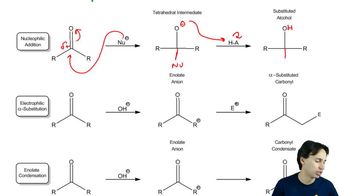
Condensation Reaction

A condensation reaction is a chemical process where two molecules combine to form a larger molecule, accompanied by the loss of a small molecule, often water. In the case of 1,4-dioxane, the condensation involves two alcohol molecules that lose water to form the cyclic ether. Understanding this reaction type is crucial for predicting the products and the conditions required for the synthesis.
Recommended video:
Guided course
05:53
Condensation Reactions

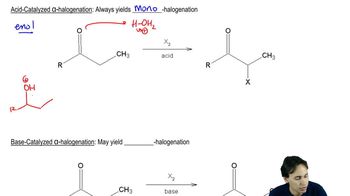
Acid-Catalyzed Reaction

An acid-catalyzed reaction involves the use of an acid to increase the rate of a chemical reaction. In the synthesis of 1,4-dioxane, the acid protonates the alcohol, making it a better leaving group and facilitating the formation of the cyclic structure. Recognizing the role of the acid catalyst is essential for understanding the mechanism and the reaction conditions.
Recommended video:
Guided course
03:09
Acid Catalyzed

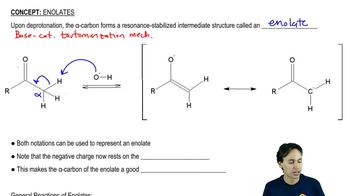
Mechanism of Dioxane Formation

The mechanism for the formation of 1,4-dioxane typically involves the formation of a protonated alcohol, followed by nucleophilic attack and the elimination of water. This stepwise process leads to the formation of the dioxane ring. A clear grasp of the mechanism is vital for predicting reaction pathways and understanding the stability of intermediates.
Recommended video:
Guided course
02:26
Formation of Enolates