
Ch. 13 - Nuclear Magnetic Resonance Spectroscopy
Wade - Organic Chemistry 9th Edition
Wade9th EditionOrganic ChemistryISBN: 9780135213728Not the one you use?Change textbook
Chapter 13, Problem 40a

Tell precisely how you would use the proton NMR spectra to distinguish between the following pairs of compounds.
(a) 1-bromopropane and 2-bromopropane

Verified step by step guidance
1
Step 1: Understand the structural differences between 1-bromopropane and 2-bromopropane. In 1-bromopropane, the bromine atom is attached to the terminal carbon, while in 2-bromopropane, the bromine atom is attached to the middle carbon.
Step 2: Analyze the proton environments in 1-bromopropane. The terminal carbon with bromine will have a unique chemical shift due to the electronegativity of bromine. Additionally, the adjacent CH2 group will experience deshielding, and the CH3 group at the other end will have a distinct chemical shift.
Step 3: Analyze the proton environments in 2-bromopropane. The middle carbon with bromine will create a different deshielding effect compared to 1-bromopropane. The CH3 groups on either side of the brominated carbon will have equivalent chemical shifts due to symmetry, and the CH group attached to bromine will have a unique shift.
Step 4: Compare the splitting patterns. In 1-bromopropane, the CH2 group adjacent to bromine will show splitting due to coupling with the CH3 group and the brominated carbon. In 2-bromopropane, the CH group attached to bromine will show splitting due to coupling with the two equivalent CH3 groups.
Step 5: Use the number of signals and their splitting patterns to distinguish the compounds. 1-bromopropane will have three distinct signals corresponding to CH3, CH2, and CH2Br, while 2-bromopropane will have two distinct signals due to the symmetry of the molecule: one for the CH group and one for the equivalent CH3 groups.

Verified video answer for a similar problem:

This video solution was recommended by our tutors as helpful for the problem above.
Video duration:
2m
Was this helpful?

Key Concepts

Here are the essential concepts you must grasp in order to answer the question correctly.

Proton NMR Spectroscopy

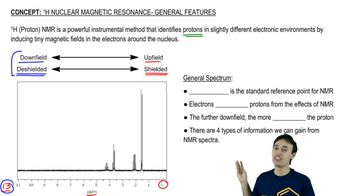
Proton Nuclear Magnetic Resonance (NMR) spectroscopy is a powerful analytical technique used to determine the structure of organic compounds. It provides information about the number of hydrogen atoms in different environments within a molecule, allowing chemists to identify functional groups and molecular connectivity. The chemical shifts in the NMR spectrum indicate the electronic environment of the protons, which can help distinguish between isomers.
Recommended video:
Guided course
10:06
General NMR Features

Chemical Shifts

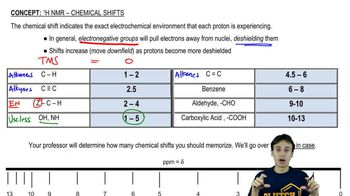
Chemical shifts in NMR spectroscopy refer to the resonance frequency of a nucleus relative to a standard in a magnetic field. They are measured in parts per million (ppm) and provide insight into the electronic environment surrounding the protons. Different substituents, such as bromine in the case of 1-bromopropane and 2-bromopropane, can cause shifts in the chemical environment, leading to distinct peaks in the NMR spectrum that can be used for differentiation.
Recommended video:
Guided course
11:44
1H NMR Chemical Shifts

Integration and Splitting Patterns

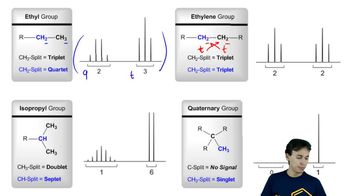
In NMR spectroscopy, integration refers to the area under the peaks, which correlates to the number of protons contributing to that signal. Splitting patterns arise from the interaction of neighboring protons, providing information about the number of adjacent hydrogen atoms. By analyzing both the integration and splitting patterns, one can distinguish between compounds like 1-bromopropane and 2-bromopropane, as they will exhibit different peak patterns due to their distinct hydrogen environments.
Recommended video:
Guided course
08:06
Common Splitting Patterns
Related Practice
Textbook Question

A small pilot plant was adding bromine across the double bond of but-2-ene to make 2,3-dibromobutane. A controller malfunction allowed the reaction temperature to rise beyond safe limits. A careful distillation of the product showed that several impurities had formed, including the one having the NMR spectra that appear below. Determine its structure, and assign the peaks to the protons in your structure.

<IMAGE>

3
views
Textbook Question

Sketch your predictions of the proton NMR spectra of the following compounds.

(b)

4
views
Textbook Question

Tell precisely how you would use the proton NMR spectra to distinguish between the following pairs of compounds.

(b)

3
views
Textbook Question

Sketch your predictions of the proton NMR spectra of the following compounds.

(a) CH3–O–CH2CH3

2
views
Textbook Question

Using a 60-MHz spectrometer, a chemist observes the following absorption: doublet, J = 7 Hz, at δ4.00

(a) What would the chemical shift (δ) be in the 300-MHz spectrum?

(b) What would the splitting value J be in the 300-MHz spectrum?

(c) How many hertz from the TMS peak is this absorption in the 60-MHz spectrum? In the 300-MHz spectrum?

3
views
Textbook Question

When 2-chloro-2-methylbutane is treated with a variety of strong bases, the products always seem to contain two isomers (A and B) of formula C5H10. When sodium hydroxide is used as the base, isomer A predominates. When potassium tert-butoxide is used as the base, isomer B predominates. The 1H and 13C NMR spectra of A and B are given below.

(a) Determine the structures of isomers A and B.

(b) Explain why A is the major product when using sodium hydroxide as the base and why B is the major product when using potassium tert-butoxide as the base.

<IMAGE>

3
views