
Ch. 13 - Nuclear Magnetic Resonance Spectroscopy
Wade - Organic Chemistry 9th Edition
Wade9th EditionOrganic ChemistryISBN: 9780135213728Not the one you use?Change textbook
Chapter 13, Problem 2a,b

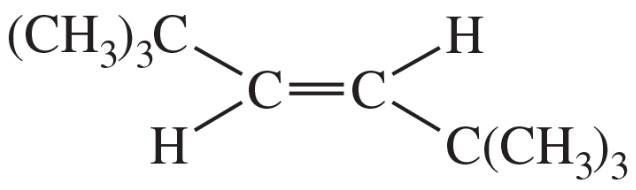
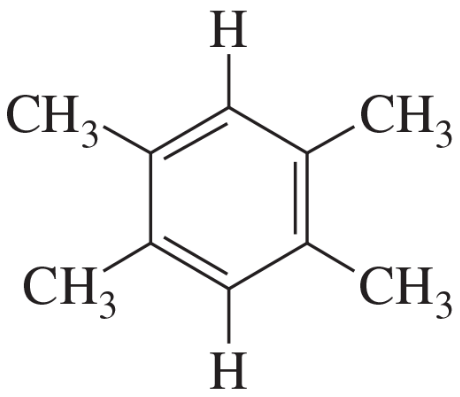
Predict the chemical shifts of the protons in the following compounds.
(a)
(b)

Verified step by step guidance
1
Step 1: Analyze the structure of compound (a). The molecule contains a double bond (C=C) with two types of protons labeled as 'a' and 'b'. The 'a' protons are directly attached to the sp2 carbons of the double bond, while the 'b' protons are part of the methyl groups attached to the sp3 carbons.
Step 2: Predict the chemical shift for the 'a' protons in compound (a). These protons are deshielded due to their proximity to the electron-withdrawing double bond. Their chemical shift is expected to be in the range of 4.5-6.5 ppm in the 1H NMR spectrum.
Step 3: Predict the chemical shift for the 'b' protons in compound (a). These protons are part of methyl groups attached to sp3 carbons, which are relatively shielded. Their chemical shift is expected to be in the range of 0.9-1.5 ppm in the 1H NMR spectrum.
Step 4: Analyze the structure of compound (b). The molecule is aromatic (benzene ring) with two types of protons labeled as 'a' and 'b'. The 'a' protons are part of the methyl groups attached to the benzene ring, while the 'b' protons are directly attached to the aromatic ring.
Step 5: Predict the chemical shifts for the protons in compound (b). The 'a' protons (methyl groups) are relatively shielded and expected to appear in the range of 2.0-2.5 ppm. The 'b' protons (aromatic hydrogens) are deshielded due to the aromatic ring and expected to appear in the range of 6.5-8.0 ppm in the 1H NMR spectrum.

Verified video answer for a similar problem:

This video solution was recommended by our tutors as helpful for the problem above.
Video duration:
4m
Was this helpful?

Key Concepts

Here are the essential concepts you must grasp in order to answer the question correctly.

Chemical Shift in NMR Spectroscopy

Chemical shift refers to the resonant frequency of a nucleus relative to a standard in a magnetic field, measured in parts per million (ppm). In proton NMR, the chemical environment surrounding a hydrogen atom affects its chemical shift, with electronegative atoms or unsaturation typically causing downfield shifts (higher ppm) due to deshielding effects.
Recommended video:
Guided course
11:44
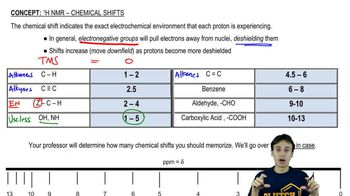
1H NMR Chemical Shifts

Steric Effects

Steric effects arise from the spatial arrangement of atoms within a molecule, influencing how closely atoms can approach each other. In the context of NMR, bulky groups can hinder the proximity of protons, affecting their chemical shifts. For example, protons on carbons adjacent to bulky substituents may experience different shifts compared to those on less hindered carbons.
Recommended video:
Guided course
02:53
Understanding steric effects.

Conjugation and Resonance

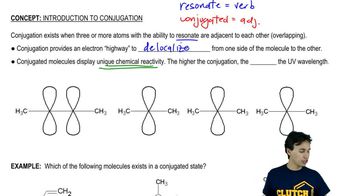
Conjugation occurs when p-orbitals overlap across adjacent double bonds or lone pairs, allowing for delocalization of electrons. This delocalization can stabilize certain molecular structures and influence the chemical shifts of protons. In alkenes, protons on carbons involved in conjugation may exhibit shifts due to the resonance effects, which can either increase or decrease their chemical shift depending on the surrounding groups.
Recommended video:
Guided course
05:29
Definition of Conjugation