Ch.11 - Reactions of Alcohols
Wade - Organic Chemistry 9th Edition
Wade9th EditionOrganic ChemistryISBN: 9780135213728Not the one you use?Change textbook
Chapter 11, Problem 11a,b

Predict the products of the following reactions.
(a) cyclohexylmethanol + TsCl/pyridine
(b) product of (a) + LiAlH4

Verified step by step guidance
1
Step 1: Analyze the reaction in part (a). Cyclohexylmethanol reacts with TsCl (tosyl chloride) in the presence of pyridine. Tosyl chloride is commonly used to convert alcohols into tosylates, which are excellent leaving groups. The hydroxyl group (-OH) of cyclohexylmethanol will be replaced by a tosyl group (-OTs). This occurs via nucleophilic substitution, where pyridine acts as a base to neutralize the HCl byproduct.
Step 2: Write the chemical transformation for part (a). Cyclohexylmethanol (C6H11CH2OH) reacts with TsCl to form cyclohexylmethyl tosylate (C6H11CH2OTs). The tosyl group is represented as -SO2C6H4CH3. This step involves the formation of a new bond between the oxygen atom of the alcohol and the sulfur atom of the tosyl group.
Step 3: Analyze the reaction in part (b). The product from part (a), cyclohexylmethyl tosylate, reacts with LiAlH4 (lithium aluminum hydride). LiAlH4 is a strong reducing agent that can reduce alkyl tosylates to alkanes. In this case, the tosyl group (-OTs) will be removed, and the hydrogen atoms from LiAlH4 will replace it, forming cyclohexylmethane.
Step 4: Write the chemical transformation for part (b). Cyclohexylmethyl tosylate (C6H11CH2OTs) reacts with LiAlH4 to form cyclohexylmethane (C6H11CH3). This reduction involves the cleavage of the C-O bond and the addition of hydrogen atoms.
Step 5: Summarize the overall reaction sequence. In part (a), cyclohexylmethanol is converted into cyclohexylmethyl tosylate via reaction with TsCl/pyridine. In part (b), cyclohexylmethyl tosylate is reduced by LiAlH4 to form cyclohexylmethane. These steps demonstrate the use of tosylation to activate an alcohol for subsequent reduction.

Verified video answer for a similar problem:

This video solution was recommended by our tutors as helpful for the problem above.
Video duration:
4m
Was this helpful?

Key Concepts

Here are the essential concepts you must grasp in order to answer the question correctly.

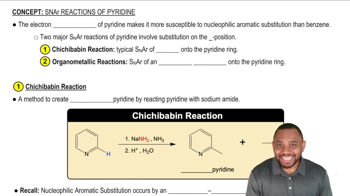
TsCl and Pyridine Reaction

The reaction of alcohols with tosyl chloride (TsCl) in the presence of a base like pyridine converts the alcohol into a tosylate, which is a better leaving group. This transformation facilitates subsequent nucleophilic substitution reactions, allowing for the formation of more reactive intermediates that can undergo further reactions.
Recommended video:
2:22
SNAr Reactions of Pyridine Concept 1

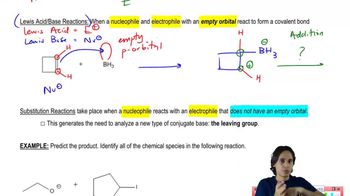
Nucleophilic Substitution

Nucleophilic substitution is a fundamental reaction in organic chemistry where a nucleophile replaces a leaving group in a molecule. In the context of the reaction products, the tosylate formed from cyclohexylmethanol can undergo substitution with a nucleophile, such as hydride from LiAlH4, leading to the formation of an alcohol or alkane.
Recommended video:
Guided course
01:47
Nucleophiles and Electrophiles can react in Substitution Reactions.

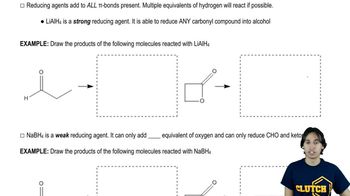
LiAlH4 as a Reducing Agent

Lithium aluminum hydride (LiAlH4) is a strong reducing agent commonly used in organic chemistry to reduce carbonyl compounds and other electrophiles. In this case, it can reduce the tosylate product from the first reaction back to an alcohol, effectively restoring the hydroxyl group and completing the transformation of the original alcohol.
Recommended video:
Guided course
09:28
Reducing Agents