Ch.11 - Reactions of Alcohols
Wade - Organic Chemistry 9th Edition
Wade9th EditionOrganic ChemistryISBN: 9780135213728Not the one you use?Change textbook
Chapter 11, Problem 39n,o,p

Predict the major products of the following reactions, including stereochemistry where appropriate.
(n) sodium ethoxide + 2-methyl-2-bromobutane
(o) octan-1-ol + DMSO + oxalyl chloride
(p) 4-cyclopentylhexan-1-ol + DMP reagent

Verified step by step guidance
1
Step 1: For reaction (n), sodium ethoxide is a strong base and nucleophile. The substrate, 2-methyl-2-bromobutane, is a tertiary alkyl halide. Analyze the reaction mechanism: tertiary alkyl halides typically undergo elimination (E2) rather than substitution due to steric hindrance. Sodium ethoxide will abstract a proton from the β-carbon, leading to the formation of an alkene. Consider Zaitsev's rule, which predicts the more substituted alkene as the major product.
Step 2: For reaction (o), octan-1-ol reacts with DMSO (dimethyl sulfoxide) and oxalyl chloride. This combination is characteristic of the Swern oxidation, which converts primary alcohols into aldehydes. The reaction proceeds via the formation of a sulfonium intermediate, followed by elimination to yield the aldehyde. Ensure no overoxidation occurs, as Swern oxidation stops at the aldehyde stage.
Step 3: For reaction (p), 4-cyclopentylhexan-1-ol reacts with the DMP reagent (Dess-Martin periodinane). This reagent is used for mild oxidation of primary alcohols to aldehydes. The reaction avoids overoxidation to carboxylic acids. The stereochemistry of the product remains unchanged since oxidation does not affect the stereocenters.
Step 4: For all reactions, carefully consider stereochemistry where applicable. In reaction (n), the stereochemistry of the alkene product depends on the anti-periplanar geometry required for the E2 elimination. In reactions (o) and (p), stereochemistry is preserved as oxidation does not alter the configuration of the molecule.
Step 5: Summarize the major products: (n) the major product is the more substituted alkene formed via E2 elimination; (o) the major product is octanal, formed via Swern oxidation; (p) the major product is 4-cyclopentylhexanal, formed via Dess-Martin oxidation. Ensure to verify the stereochemistry and functional group transformations for each reaction.

Verified video answer for a similar problem:

This video solution was recommended by our tutors as helpful for the problem above.
Video duration:
10m
Was this helpful?

Key Concepts

Here are the essential concepts you must grasp in order to answer the question correctly.

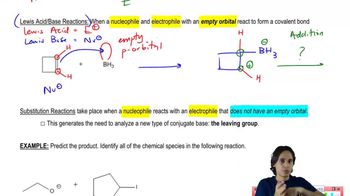
Nucleophilic Substitution Reactions

Nucleophilic substitution reactions involve the replacement of a leaving group in a molecule by a nucleophile. In the context of the reactions provided, sodium ethoxide acts as a strong nucleophile that can attack the electrophilic carbon attached to the bromine in 2-methyl-2-bromobutane, leading to the formation of an ether or an alkane, depending on the reaction conditions.
Recommended video:
Guided course
01:47
Nucleophiles and Electrophiles can react in Substitution Reactions.

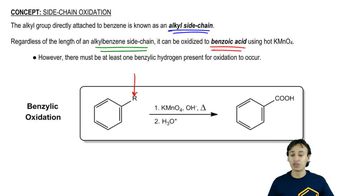
Oxidation Reactions

Oxidation reactions involve the increase of oxidation state of a molecule, often through the addition of oxygen or the removal of hydrogen. In the reaction involving octan-1-ol and DMSO with oxalyl chloride, the alcohol is oxidized to a carbonyl compound, typically an aldehyde or ketone, depending on the reaction conditions and the reagents used.
Recommended video:
Guided course
03:20
Benzylic Oxidation

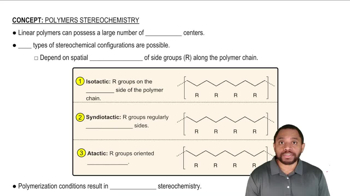
Stereochemistry

Stereochemistry refers to the study of the spatial arrangement of atoms in molecules and how this affects their chemical behavior. In predicting the products of reactions, especially those involving chiral centers, it is crucial to consider stereochemical outcomes, such as whether the product is formed as a specific enantiomer or diastereomer, which can significantly influence the properties and reactivity of the resulting compounds.
Recommended video:
1:38
Polymer Stereochemistry Concept 1