Ch.11 - Reactions of Alcohols
Wade - Organic Chemistry 9th Edition
Wade9th EditionOrganic ChemistryISBN: 9780135213728Not the one you use?Change textbook
Chapter 11, Problem 36

Phenols (pKa ≈ 10) are more acidic than other alcohols, so they are easily deprotonated by sodium hydroxide or potassium hydroxide. The anions of phenols (phenoxide ions) can be used in the Williamson ether synthesis, especially with very reactive alkylating reagents such as dimethyl sulfate. Using phenol, dimethyl sulfate, and other necessary reagents, show how you would synthesize methyl phenyl ether.

Verified step by step guidance
1
Step 1: Begin by understanding the acidity of phenol. Phenol has a pKa of approximately 10, making it more acidic than other alcohols. This means it can be deprotonated by a strong base such as sodium hydroxide (NaOH) or potassium hydroxide (KOH).
Step 2: Deprotonate phenol using sodium hydroxide (NaOH). The hydroxide ion (OH⁻) will abstract the proton from the hydroxyl group of phenol, forming the phenoxide ion (C₆H₅O⁻). This reaction can be represented as: C6H5(OH)+Na(OH)C6H5(O)+Na(H)
Step 3: Introduce dimethyl sulfate ((CH₃O)₂SO₂) as the alkylating agent. Dimethyl sulfate is highly reactive and can transfer a methyl group to the phenoxide ion. The phenoxide ion acts as a nucleophile, attacking the methyl group on dimethyl sulfate, leading to the formation of methyl phenyl ether (C₆H₅OCH₃).
Step 4: Write the reaction mechanism for the Williamson ether synthesis. The phenoxide ion (C₆H₅O⁻) performs a nucleophilic attack on the methyl group of dimethyl sulfate, displacing the sulfate group. This can be represented as: C6H5(O)+(CH3O)SO2C6H5(OCH3)+SO4²⁻
Step 5: Isolate and purify the product, methyl phenyl ether (C₆H₅OCH₃). This can be done using standard organic chemistry techniques such as distillation or extraction, depending on the reaction conditions and the physical properties of the product.

Verified video answer for a similar problem:

This video solution was recommended by our tutors as helpful for the problem above.
Video duration:
5m
Was this helpful?

Key Concepts

Here are the essential concepts you must grasp in order to answer the question correctly.

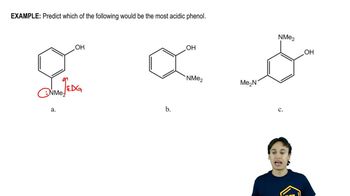
Acidity of Phenols

Phenols are organic compounds characterized by a hydroxyl group (-OH) attached to an aromatic ring. Their acidity, indicated by a pKa of approximately 10, is due to the resonance stabilization of the phenoxide ion formed upon deprotonation. This makes phenols more acidic than typical alcohols, allowing them to react with strong bases like sodium hydroxide to form phenoxide ions.
Recommended video:
Guided course
02:27
Identify the most acidic phenol

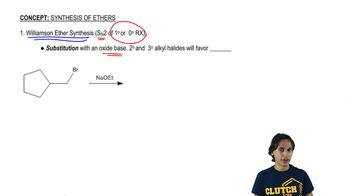
Williamson Ether Synthesis

The Williamson ether synthesis is a method for creating ethers through the reaction of an alkoxide ion with a primary alkyl halide. In this process, the phenoxide ion generated from phenol acts as a nucleophile, attacking the electrophilic carbon of the alkyl halide, such as dimethyl sulfate, to form the desired ether product. This reaction is particularly effective with reactive alkylating agents.
Recommended video:
Guided course
03:50
The Mechanism of Williamson Ether Synthesis.

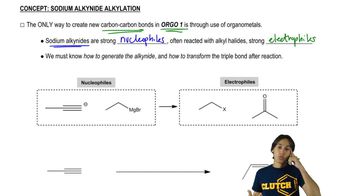
Reactivity of Alkylating Reagents

Alkylating reagents are compounds that can transfer an alkyl group to a nucleophile, facilitating the formation of new carbon-carbon or carbon-heteroatom bonds. Dimethyl sulfate is a highly reactive alkylating agent that can readily react with nucleophiles like phenoxide ions. Its reactivity is crucial in the synthesis of ethers, as it allows for efficient alkylation under mild conditions.
Recommended video:
Guided course
03:19
Sodium Alkynide Alkylation
Related Practice
Textbook Question

To practice working through the early parts of a multistep synthesis, devise syntheses of

(b) 3-ethylpentan-2-one from compounds containing no more than three carbon atoms.

2
views

Textbook Question

To practice working through the early parts of a multistep synthesis, devise syntheses of

(a) pentan-3-one from alcohols containing no more than three carbon atoms.

5
views
Textbook Question

A student wanted to use the Williamson ether synthesis to make (R)-2-ethoxybutane. He remembered that the Williamson synthesis involves an SN2 displacement, which takes place with inversion of configuration. He ordered a bottle of (S)-butan-2-ol for his chiral starting material. He also remembered that the SN2 goes best on primary halides and tosylates, so he made ethyl tosylate and sodium (S)-but-2-oxide. After warming these reagents together, he obtained an excellent yield of 2-ethoxybutane.

a. What enantiomer of 2-ethoxybutane did he obtain? Explain how this enantiomer results from the SN2 reaction of ethyl tosylate with sodium (S)-but-2-oxide.

b. What would have been the best synthesis of (R)-2-ethoxybutane?

c. How can this student convert the rest of his bottle of (S)-butan-2-ol to (R)-2-ethoxybutane?

1
views
Textbook Question

A good Williamson synthesis of ethyl methyl ether would be

What is wrong with the following proposed synthesis of ethyl methyl ether? First, ethanol is treated with acid to protonate the hydroxy group (making it a good leaving group), and then sodium methoxide is added to displace water.

9
views
Textbook Question

(a) Show how ethanol and cyclohexanol may be used to synthesize cyclohexyl ethyl ether (tosylation followed by the Williamson ether synthesis).

(b) Why can't we synthesize this product simply by mixing the two alcohols, adding some sulfuric acid, and heating?

1
views
Textbook Question

Develop syntheses for the following compounds. As starting materials, you may use cyclopentanol, alcohols containing no more than four carbon atoms, and any common reagents and solvents.

(a) trans-cyclopentane-1,2-diol

1
views