Ch.11 - Reactions of Alcohols
Wade - Organic Chemistry 9th Edition
Wade9th EditionOrganic ChemistryISBN: 9780135213728Not the one you use?Change textbook
Chapter 11, Problem 38b

Develop syntheses for the following compounds. As starting materials, you may use cyclopentanol, alcohols containing no more than four carbon atoms, and any common reagents and solvents.
(b) 1-chloro-1-ethylcyclopentane

Verified step by step guidance
1
Step 1: Begin with cyclopentanol as the starting material. Convert cyclopentanol to cyclopentyl bromide using phosphorus tribromide (PBr₃) as the reagent. This reaction replaces the hydroxyl group (-OH) with a bromine atom (-Br).
Step 2: Perform a Grignard reaction to introduce the ethyl group. React cyclopentyl bromide with magnesium (Mg) in dry ether to form cyclopentyl magnesium bromide, a Grignard reagent.
Step 3: React the Grignard reagent (cyclopentyl magnesium bromide) with ethyl bromide (CH₃CH₂Br). This reaction will couple the ethyl group to the cyclopentyl structure, forming 1-ethylcyclopentane.
Step 4: Introduce the chlorine atom at the 1-position. React 1-ethylcyclopentane with chlorine gas (Cl₂) in the presence of UV light or heat. This will result in a free radical halogenation, selectively forming 1-chloro-1-ethylcyclopentane.
Step 5: Purify the product using standard organic purification techniques, such as distillation or recrystallization, to isolate 1-chloro-1-ethylcyclopentane.

Verified video answer for a similar problem:

This video solution was recommended by our tutors as helpful for the problem above.
Video duration:
6m
Was this helpful?

Key Concepts

Here are the essential concepts you must grasp in order to answer the question correctly.

Nucleophilic Substitution

Nucleophilic substitution is a fundamental reaction in organic chemistry where a nucleophile attacks an electrophile, resulting in the replacement of a leaving group. In the context of synthesizing 1-chloro-1-ethylcyclopentane, understanding how nucleophiles can displace halides is crucial. This concept is essential for designing pathways that involve the formation of carbon-carbon bonds and the introduction of functional groups.
Recommended video:
Guided course
01:47
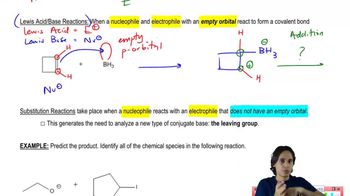
Nucleophiles and Electrophiles can react in Substitution Reactions.

Reactivity of Alcohols

Alcohols are versatile compounds that can undergo various reactions, including dehydration, oxidation, and substitution. In this synthesis, alcohols with four or fewer carbon atoms can be converted into alkyl halides through reactions with reagents like thionyl chloride or phosphorus tribromide. Recognizing the reactivity of alcohols is vital for selecting appropriate starting materials and reagents to achieve the desired product.
Recommended video:
Guided course
01:01
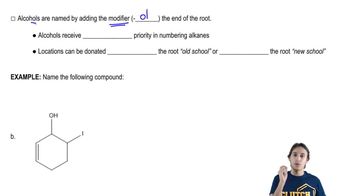
How to name alcohols

Cyclopentane Derivatives

Cyclopentane derivatives are cyclic compounds that can undergo various transformations to introduce substituents or functional groups. In synthesizing 1-chloro-1-ethylcyclopentane, understanding the structure and reactivity of cyclopentane is important for planning the synthesis. This includes knowing how to manipulate the ring structure and utilize reagents that can effectively add or modify substituents on the cyclopentane framework.
Recommended video:
Guided course
02:49
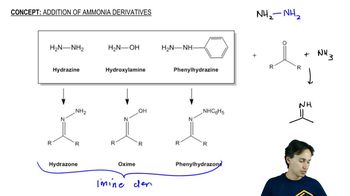
Ammonia Derivatives