
Ch.11 - Reactions of Alcohols
Wade - Organic Chemistry 9th Edition
Wade9th EditionOrganic ChemistryISBN: 9780135213728Not the one you use?Change textbook
Chapter 11, Problem 63b

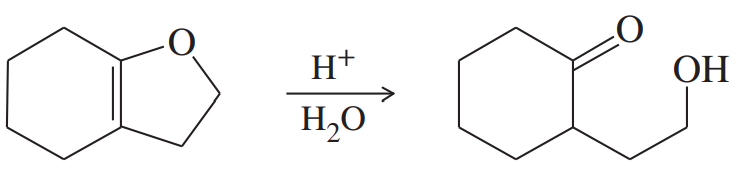
Alcohols combine with ketones and aldehydes to form interesting derivatives, which we will discuss in Chapter 18. The following reactions show the hydrolysis of two such derivatives. Propose mechanisms for these reactions.
(b) Chemical reaction diagram illustrating the hydrolysis of ketone and aldehyde derivatives with water and acid catalyst.

Verified step by step guidance
1
Step 1: Analyze the starting material and product. The starting material is a cyclic acetal (a compound with two ether groups attached to the same carbon), and the product is a ketone with a hydroxyl group attached to the adjacent carbon. This indicates hydrolysis of the acetal under acidic conditions.
Step 2: Protonation of the acetal oxygen. In the presence of acid (H⁺), one of the ether oxygen atoms in the acetal is protonated, increasing its electrophilicity and making the carbon attached to it more susceptible to nucleophilic attack.
Step 3: Water attacks the protonated acetal. A molecule of water (H₂O) acts as a nucleophile and attacks the electrophilic carbon, leading to the formation of a tetrahedral intermediate.
Step 4: Cleavage of the acetal bond. The tetrahedral intermediate undergoes bond cleavage, releasing one of the ether groups as an alcohol and forming a hemiacetal intermediate.
Step 5: Further hydrolysis of the hemiacetal. The hemiacetal undergoes another round of protonation and nucleophilic attack by water, leading to the formation of the final product: a ketone and an alcohol group.

Verified video answer for a similar problem:

This video solution was recommended by our tutors as helpful for the problem above.
Video duration:
3m
Was this helpful?

Key Concepts

Here are the essential concepts you must grasp in order to answer the question correctly.

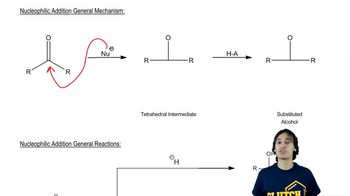
Nucleophilic Addition

Nucleophilic addition is a fundamental reaction in organic chemistry where a nucleophile attacks an electrophilic carbon atom, typically found in carbonyl groups of aldehydes and ketones. This process leads to the formation of a tetrahedral intermediate, which can further react to yield various products, including alcohols. Understanding this mechanism is crucial for analyzing how alcohols interact with carbonyl compounds to form derivatives.
Recommended video:
Guided course
08:27
Nucleophilic Addition

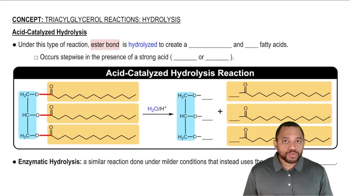
Hydrolysis Reactions

Hydrolysis reactions involve the breaking of chemical bonds through the reaction with water, often resulting in the formation of alcohols and acids. In the context of the question, hydrolysis of derivatives formed from alcohols and carbonyl compounds is essential to understand how these compounds revert to their original forms or transform into new products. Recognizing the conditions and mechanisms of hydrolysis is key to proposing accurate reaction mechanisms.
Recommended video:
3:09
Triacylglycerol Reactions: Hydrolysis Concept 3

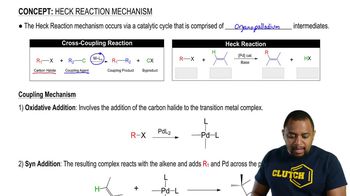
Reaction Mechanisms

A reaction mechanism is a step-by-step description of the pathway taken during a chemical reaction, detailing the sequence of elementary steps and the intermediates formed. Understanding reaction mechanisms is vital for predicting the products of reactions and for proposing how specific transformations occur. In this case, analyzing the mechanisms of hydrolysis for the derivatives formed from alcohols and carbonyls will help elucidate the overall reaction process.
Recommended video:
Guided course
02:16
Heck Reaction Mechanism
Related Practice
Textbook Question

(b) Under the same conditions, an optically active sample of trans-2-bromocyclopentanol reacts with concentrated aqueous HBr to give an optically inactive product, (racemic) trans-1,2-dibromocyclopentane. Propose a mechanism to show how this reaction goes with apparently complete retention of configuration, yet with racemization. (Hint: Draw out the mechanism of the reaction of cyclopentene with Br2 in water to give the starting material, trans-2- bromocyclopentanol. Consider how parts of this mechanism might be involved in the reaction with HBr.)

1
views
Textbook Question

(a) The reaction of butan-2-ol with concentrated aqueous HBr goes with partial racemization, giving more inversion than retention of configuration. Propose a mechanism that accounts for racemization with excess inversion.

Textbook Question

Under normal circumstances, tertiary alcohols are not oxidized. However, when the tertiary alcohol is allylic, it can undergo a migration of the double bond (called an allylic shift) and subsequent oxidation of the alcohol. A particularly effective reagent for this reaction is Bobbitt's reagent, similar to TEMPO used in many oxidations. (M. Shibuya et al., J. Org. Chem., 2008, 73, 4750.)

Show the expected product when each of these 3° allylic alcohols is oxidized by Bobbitt's reagent.

(a)

(b)

1
views
Textbook Question

Under normal circumstances, tertiary alcohols are not oxidized. However, when the tertiary alcohol is allylic, it can undergo a migration of the double bond (called an allylic shift) and subsequent oxidation of the alcohol. A particularly effective reagent for this reaction is Bobbitt's reagent, similar to TEMPO used in many oxidations. (M. Shibuya et al., J. Org. Chem., 2008, 73, 4750.)

Show the expected product when each of these 3° allylic alcohols is oxidized by Bobbitt’s reagent

(c)

(d)

4
views
Textbook Question

Alcohols combine with ketones and aldehydes to form interesting derivatives, which we will discuss in Chapter 18. The following reactions show the hydrolysis of two such derivatives. Propose mechanisms for these reactions.

(a)

1
views