Ch.10 - Structure and Synthesis of Alcohols
Wade - Organic Chemistry 9th Edition
Wade9th EditionOrganic ChemistryISBN: 9780135213728Not the one you use?Change textbook
Chapter 10, Problem 11a-h

Which of the following compounds are suitable solvents for Grignard reactions?
(a) n-hexane
(b) CH3–O–CH3
(c) CHCl3
(d) cyclohexane
(e) benzene
(f) CH3OCH2CH2OCH3
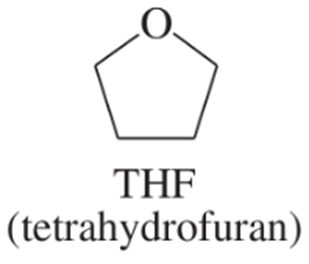
(g)
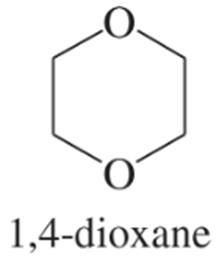
(h)

Verified step by step guidance
1
Step 1: Understand the requirements for a solvent to be suitable for Grignard reactions. Grignard reagents are highly reactive and can be destroyed by protic solvents or solvents containing acidic hydrogen atoms. Suitable solvents must be aprotic and non-reactive with the Grignard reagent.
Step 2: Analyze each compound provided in the list. For example, n-hexane (a) and cyclohexane (d) are non-polar hydrocarbons and do not contain any reactive groups that would interfere with Grignard reagents, making them suitable solvents.
Step 3: Evaluate ethers such as CH3-O-CH3 (b) and CH3OCH2CH2OCH3 (f). Ethers are commonly used solvents for Grignard reactions because they are aprotic and can stabilize the Grignard reagent through coordination with the magnesium atom.
Step 4: Examine compounds like CHCl3 (c) and benzene (e). CHCl3 contains acidic hydrogen atoms and is unsuitable for Grignard reactions. Benzene is non-polar and inert, making it a suitable solvent.
Step 5: Assess the cyclic ethers provided in the image, (vii) and (viii). Both are cyclic ethers, which are aprotic and can stabilize Grignard reagents through coordination. Therefore, they are suitable solvents for Grignard reactions.

Verified video answer for a similar problem:

This video solution was recommended by our tutors as helpful for the problem above.
Video duration:
9m
Was this helpful?

Key Concepts

Here are the essential concepts you must grasp in order to answer the question correctly.

Grignard Reagents

Grignard reagents are organomagnesium compounds formed by the reaction of magnesium with alkyl or aryl halides. They are highly reactive and serve as nucleophiles in organic synthesis, particularly in forming carbon-carbon bonds. Understanding their reactivity is crucial for determining suitable solvents, as they can react with protic solvents, leading to the destruction of the Grignard reagent.
Recommended video:
Guided course
02:12
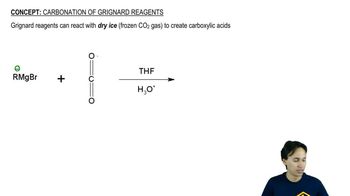
Carbonation of Grignard Reagents

Solvent Properties

The choice of solvent in Grignard reactions is critical, as it must be an aprotic solvent that does not contain acidic protons. Suitable solvents, such as ethers, stabilize the Grignard reagent without participating in the reaction. Common examples include diethyl ether and tetrahydrofuran (THF), which provide a non-reactive environment for the reaction to proceed effectively.
Recommended video:
Guided course
01:16
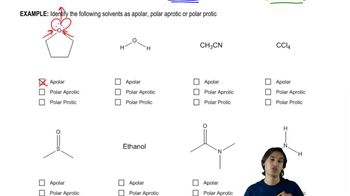
Identification of polarity in solvents

Reactivity of Solvents

Different solvents exhibit varying degrees of reactivity with Grignard reagents. For instance, solvents like water or alcohols can protonate Grignard reagents, rendering them ineffective. In contrast, hydrocarbons like n-hexane and cyclohexane are non-polar and do not react with Grignard reagents, making them unsuitable for facilitating the desired reactions. Understanding these interactions is essential for selecting appropriate solvents.
Recommended video:
Guided course
01:16
Identification of polarity in solvents