
Authentic skunk spray has become valuable for use in scent-masking products. Show how you would synthesize the major component of skunk spray (3-methylbutane-1-thiol and but-2-ene-1-thiol) from any of the readily available butene or from buta-1,3-diene.
Ch.10 - Structure and Synthesis of Alcohols
Chapter 10, Problem 26d
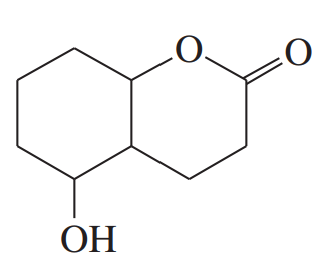
Show how you would synthesize the following alcohol by reducing appropriate carbonyl compound.
(d) 
Verified step by step guidance1
Step 1: Analyze the target molecule. The structure contains a secondary alcohol group (-OH) attached to a cyclohexane ring and an ester functional group. The alcohol group likely originates from the reduction of a carbonyl compound.
Step 2: Identify the precursor carbonyl compound. To synthesize the secondary alcohol, the precursor is likely a ketone. The ketone would have the same cyclohexane ring structure with a carbonyl group (C=O) at the position where the alcohol is now located.
Step 3: Select an appropriate reducing agent. Common reducing agents for converting ketones to secondary alcohols include sodium borohydride (NaBH₄) or lithium aluminum hydride (LiAlH₄). NaBH₄ is typically used for mild reductions, while LiAlH₄ is more reactive and can reduce esters as well.
Step 4: Perform the reduction reaction. Treat the ketone precursor with the chosen reducing agent in a suitable solvent (e.g., ethanol or tetrahydrofuran). This will convert the carbonyl group into the secondary alcohol group.
Step 5: Verify the product. After the reduction, confirm the structure of the synthesized alcohol using spectroscopic techniques such as NMR or IR to ensure the correct functional groups are present and the desired alcohol has been formed.

Verified video answer for a similar problem:
This video solution was recommended by our tutors as helpful for the problem above.
Video duration:
2mWas this helpful?
Key Concepts
Here are the essential concepts you must grasp in order to answer the question correctly.
Reduction of Carbonyl Compounds
Reduction of carbonyl compounds involves the conversion of a carbonyl group (C=O) into an alcohol (C-OH) by adding hydrogen or removing oxygen. Common reducing agents include lithium aluminum hydride (LiAlH4) and sodium borohydride (NaBH4). Understanding the mechanism of this reaction is crucial for synthesizing alcohols from ketones or aldehydes.
Recommended video:
Guided course
Defining meso compounds.
Types of Carbonyl Compounds
Carbonyl compounds can be classified into aldehydes and ketones, which differ in their structure and reactivity. Aldehydes have at least one hydrogen atom attached to the carbonyl carbon, while ketones have two carbon groups. Identifying the correct type of carbonyl compound is essential for determining the appropriate reduction method to synthesize the desired alcohol.
Recommended video:
Guided course
Defining meso compounds.
Stereochemistry of Alcohols
Stereochemistry refers to the spatial arrangement of atoms in molecules and is particularly important in organic synthesis. Alcohols can exist as chiral molecules, leading to different enantiomers. When synthesizing an alcohol from a carbonyl compound, it is important to consider the stereochemical outcome, as it can affect the properties and reactivity of the final product.
Recommended video:
Polymer Stereochemistry Concept 1
Related Practice
Textbook Question
1
views
Textbook Question
Predict the products you would expect from the reaction of LiAlH4 followed by hydrolysis with the following compounds. You may assume that these reactions take place in methanol as the solvent.
(e)
1
views
Textbook Question
Give IUPAC names for the following compounds.
1
views
Textbook Question
Arrange the following compounds in order of decreasing acidity.
CH3COOH, CH3OH, CH3CH3, CH3SO3H, CH3NH2, CH3SH, CH3C≡CH
1
views
Textbook Question
Show how you would synthesize the following alcohol by reducing appropriate carbonyl compound.
c. 2-methylhexan-3-ol
2
views
Textbook Question
Show how you would synthesize the following alcohol by reducing appropriate carbonyl compound.
a. heptan-1-ol
1
views
