Ch.10 - Structure and Synthesis of Alcohols
Wade - Organic Chemistry 9th Edition
Wade9th EditionOrganic ChemistryISBN: 9780135213728Not the one you use?Change textbook
Chapter 10, Problem 24d

Predict the products you would expect from the reaction of NaBH4 with the following compounds. You may assume that these reactions take place in methanol as the solvent.
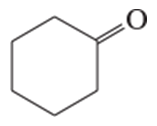
(d)

Verified step by step guidance
1
Step 1: Identify the functional group in the given compound. The structure provided is a cyclic ketone, specifically cyclohexanone, which contains a carbonyl group (C=O).
Step 2: Understand the role of NaBH4 in organic reactions. Sodium borohydride (NaBH4) is a reducing agent commonly used to reduce ketones and aldehydes to their corresponding alcohols.
Step 3: Predict the reaction mechanism. NaBH4 donates hydride ions (H⁻) to the electrophilic carbon of the carbonyl group, breaking the double bond and forming a single bond with the addition of a hydrogen atom.
Step 4: Consider the solvent methanol. Methanol acts as a proton source, providing a hydrogen atom to the oxygen atom of the carbonyl group, completing the reduction process.
Step 5: Determine the product. The reduction of cyclohexanone with NaBH4 in methanol will yield cyclohexanol, a secondary alcohol, as the product.

Verified video answer for a similar problem:

This video solution was recommended by our tutors as helpful for the problem above.
Video duration:
2m
Was this helpful?

Key Concepts

Here are the essential concepts you must grasp in order to answer the question correctly.

Sodium Borohydride (NaBH4) as a Reducing Agent

Sodium borohydride (NaBH4) is a mild reducing agent commonly used in organic chemistry to reduce carbonyl compounds, such as aldehydes and ketones, to their corresponding alcohols. It donates hydride ions (H-) to the electrophilic carbon of the carbonyl group, facilitating the reduction process. Understanding its reactivity and selectivity is crucial for predicting the products of reactions involving NaBH4.
Recommended video:
Guided course
09:28
Reducing Agents

Mechanism of Reduction Reactions

The mechanism of reduction reactions typically involves the nucleophilic attack of the hydride ion on the carbonyl carbon, followed by protonation to form an alcohol. This process can be visualized in two steps: first, the formation of a tetrahedral intermediate, and then the collapse of this intermediate to yield the alcohol product. Familiarity with this mechanism helps in predicting the outcome of reactions involving carbonyl compounds.
Recommended video:
Guided course
04:40
Birch Reduction Mechanism

Solvent Effects in Organic Reactions

The choice of solvent can significantly influence the course of organic reactions. In this case, methanol serves as a polar protic solvent, which can stabilize charged intermediates and facilitate proton transfer. Understanding how solvents affect reaction rates, product distribution, and the stability of intermediates is essential for accurately predicting the products of the reaction with NaBH4.
Recommended video:
Guided course
02:26
General format of reactions and how to interpret solvents.