
Textbook Question
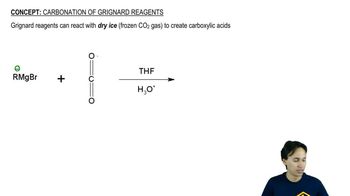
Determine the structures of compounds A through G, including stereochemistry where appropriate.
1
views


 Verified step by step guidance
 02:12
02:12
 01:17
01:17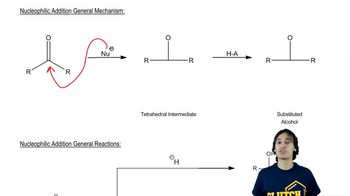 08:27
08:27Determine the structures of compounds A through G, including stereochemistry where appropriate.
Propose structures for intermediates and products (A) through (D)
Compound A (C7H11Br) is treated with magnesium in ether to give B (C7H11MgBr), which reacts violently with D2O to give 1-methylcyclohexene with a deuterium atom on the methyl group (C). Reaction of B with acetone (CH3COCH3) followed by hydrolysis gives D (C10H18O). Heating D with concentrated H2SO4 gives E (C10H16), which decolorizes two equivalents of Br2 to give F (C10H16Br4). E undergoes hydrogenation with excess H2 and a Pt catalyst to give isobutylcyclohexane. Determine the structures of compounds A through F, and show your reasoning throughout.
Vinyl alcohols are generally unstable, quickly isomerizing to carbonyl compounds. Propose mechanisms for the following isomerizations.
(c)
Vinyl alcohols are generally unstable, quickly isomerizing to carbonyl compounds. Propose mechanisms for the following isomerizations.
(b)
Many hunting dogs enjoy standing nose-to-nose with a skunk while barking furiously, oblivious to the skunk spray directed toward them. One moderately effective way of lessening the amount of odor is to wash the dog in a bath containing dilute hydrogen peroxide, sodium bicarbonate, and some mild dish detergent. Use chemical reactions to describe how this mixture helps to remove the skunk spray from the dog. The two major components of skunk oil are 3-methylbutane-1-thiol and but-2-ene-1-thiol.