Ch.10 - Structure and Synthesis of Alcohols
Wade - Organic Chemistry 9th Edition
Wade9th EditionOrganic ChemistryISBN: 9780135213728Not the one you use?Change textbook
Chapter 10, Problem 18b

A formate ester, such as ethyl formate, reacts with an excess of a Grignard reagent to give (after protonation) secondary alcohols with two identical alkyl groups.

(b) Show how you would use reactions of Grignard reagents with ethyl formate to synthesize the following secondary alcohols.
(i) pentan-3-ol
(ii) diphenylmethanol
(iii) trans,trans-nona-2,7-dien-5-ol

Verified step by step guidance
1
Step 1: Understand the reaction mechanism. Grignard reagents (R-MgX) react with esters to form ketones as intermediates. When an excess of the Grignard reagent is used, the ketone reacts further to form a tertiary alcohol after protonation. In this case, ethyl formate (HCOOCH2CH3) reacts with the Grignard reagent to form a secondary alcohol with two identical alkyl groups.
Step 2: For (i) pentan-3-ol, identify the Grignard reagent needed. Pentan-3-ol has two identical ethyl groups attached to the central carbon. To synthesize this, use ethylmagnesium bromide (CH3CH2MgBr) as the Grignard reagent. React ethyl formate with two equivalents of ethylmagnesium bromide, followed by protonation, to obtain pentan-3-ol.
Step 3: For (ii) diphenylmethanol, identify the Grignard reagent needed. Diphenylmethanol has two phenyl groups attached to the central carbon. To synthesize this, use phenylmagnesium bromide (C6H5MgBr) as the Grignard reagent. React ethyl formate with two equivalents of phenylmagnesium bromide, followed by protonation, to obtain diphenylmethanol.
Step 4: For (iii) trans,trans-nona-2,7-dien-5-ol, identify the Grignard reagent needed. This compound has two identical trans,trans-butadienyl groups attached to the central carbon. To synthesize this, use trans,trans-butadienylmagnesium bromide (CH2=CH-CH=CHMgBr) as the Grignard reagent. React ethyl formate with two equivalents of trans,trans-butadienylmagnesium bromide, followed by protonation, to obtain trans,trans-nona-2,7-dien-5-ol.
Step 5: Generalize the process. For each target secondary alcohol, the key is to identify the Grignard reagent that corresponds to the desired alkyl group. React ethyl formate with two equivalents of the chosen Grignard reagent, then protonate the resulting product to obtain the desired secondary alcohol.

Verified video answer for a similar problem:

This video solution was recommended by our tutors as helpful for the problem above.
Video duration:
7m
Was this helpful?

Key Concepts

Here are the essential concepts you must grasp in order to answer the question correctly.

Grignard Reagents

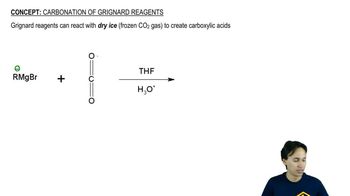
Grignard reagents are organomagnesium compounds that act as nucleophiles in organic reactions. They are formed by reacting alkyl or aryl halides with magnesium metal in dry ether. Grignard reagents can react with carbonyl compounds, such as esters, to form alcohols after protonation. Understanding their reactivity is crucial for synthesizing various alcohols from carbonyl precursors.
Recommended video:
Guided course
02:12
Carbonation of Grignard Reagents

Ester Reactions

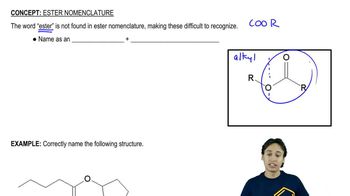
Esters, like ethyl formate, can undergo nucleophilic addition reactions with Grignard reagents. When a Grignard reagent attacks the carbonyl carbon of an ester, it forms a tetrahedral intermediate, which can lead to the formation of a secondary alcohol after protonation. This reaction is essential for constructing complex alcohols from simpler ester starting materials.
Recommended video:
Guided course
02:39
Ester Nomenclature

Synthesis of Secondary Alcohols

Secondary alcohols can be synthesized by the reaction of Grignard reagents with esters, where the resulting product has two identical alkyl groups. The choice of Grignard reagent determines the structure of the final alcohol. For example, using a specific Grignard reagent with ethyl formate can yield pentan-3-ol or diphenylmethanol, showcasing the versatility of this synthetic approach.
Recommended video:
Guided course
01:44
Forming alcohols through SN2 reactions.