Ch. 2 - Acids and Bases; Functional Groups
Wade - Organic Chemistry 9th Edition
Wade9th EditionOrganic ChemistryISBN: 9780135213728Not the one you use?Change textbook
Chapter 2, Problem 42e

Predict the products of the following acid–base reactions.
(e) H2O + NH3

Verified step by step guidance
1
Identify the acid and base in the reaction. In this case, water (H2O) can act as an acid, donating a proton (H⁺), and ammonia (NH3) can act as a base, accepting a proton.
Write the chemical equation for the proton transfer. Water donates a proton to ammonia, forming hydroxide ion (OH⁻) and ammonium ion (NH4⁺).
Use MathML to represent the chemical equation: H2O+NH3OH-+NH4+
Consider the equilibrium of the reaction. The double arrow (⇌) indicates that the reaction can proceed in both directions, meaning the products can revert to reactants.
Understand the concept of conjugate acid-base pairs. In this reaction, NH3 and NH4⁺ are a conjugate acid-base pair, and H2O and OH⁻ are another conjugate acid-base pair.

Verified video answer for a similar problem:

This video solution was recommended by our tutors as helpful for the problem above.
Video duration:
3m
Was this helpful?

Key Concepts

Here are the essential concepts you must grasp in order to answer the question correctly.

Acid-Base Reaction

An acid-base reaction involves the transfer of a proton (H+) from an acid to a base. In the given reaction, water (H2O) acts as an acid, donating a proton to ammonia (NH3), which acts as a base. Understanding the roles of acids and bases is crucial for predicting the products of such reactions.
Recommended video:
Guided course
02:49
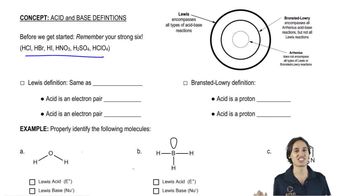
The Lewis definition of acids and bases.

Bronsted-Lowry Acid and Base

The Bronsted-Lowry theory defines acids as proton donors and bases as proton acceptors. In the reaction H2O + NH3, H2O donates a proton to NH3, forming OH- and NH4+. This concept helps in identifying the conjugate acid-base pairs and predicting the products formed in the reaction.
Recommended video:
Guided course
00:54
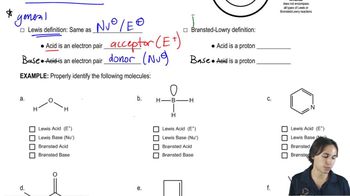
The Bronsted-Lowry definition of acids and bases.

Conjugate Acid-Base Pair

A conjugate acid-base pair consists of two species that differ by a proton. In the reaction, H2O and OH- form a conjugate acid-base pair, while NH3 and NH4+ form another. Recognizing these pairs is essential for understanding the equilibrium and direction of acid-base reactions.
Recommended video:
2:56
Base Pairing Concept 1