Ch. 2 - Acids and Bases; Functional Groups
Wade - Organic Chemistry 9th Edition
Wade9th EditionOrganic ChemistryISBN: 9780135213728Not the one you use?Change textbook
Chapter 2, Problem 34b

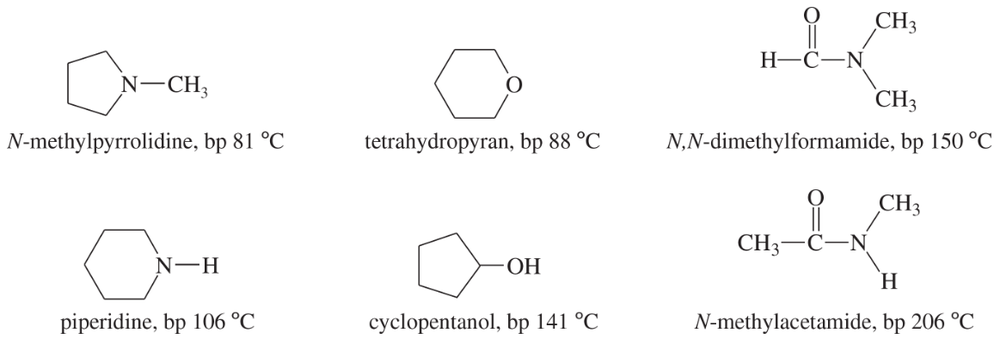
N-Methylpyrrolidine has a boiling point of 81 °C, and piperidine has a boiling point of 106 °C.
b. Tetrahydropyran has a boiling point of 88 °C, and cyclopentanol has a boiling point of 141 °C. These two isomers have a boiling point difference of 53 °C. Explain why the two oxygen-containing isomers have a much larger boiling point difference than the two amine isomers.

Verified step by step guidance
1
Identify the functional groups present in each compound. N-Methylpyrrolidine and piperidine are amines, while tetrahydropyran and cyclopentanol contain oxygen in the form of an ether and an alcohol, respectively.
Understand the impact of hydrogen bonding on boiling points. Alcohols, like cyclopentanol, can form strong hydrogen bonds due to the presence of the hydroxyl group (OH), which significantly increases their boiling point compared to ethers like tetrahydropyran, which cannot form hydrogen bonds as effectively.
Compare the molecular structures and intermolecular forces. Cyclopentanol, with its hydroxyl group, can engage in hydrogen bonding, leading to a higher boiling point. Tetrahydropyran, lacking a hydroxyl group, relies on weaker dipole-dipole interactions.
Examine the amine isomers. Both N-Methylpyrrolidine and piperidine can form hydrogen bonds due to the presence of nitrogen, but the difference in boiling points is less pronounced because the nitrogen atom in amines forms weaker hydrogen bonds compared to the oxygen atom in alcohols.
Conclude that the larger boiling point difference between the oxygen-containing isomers is primarily due to the ability of cyclopentanol to form strong hydrogen bonds, whereas tetrahydropyran cannot, resulting in a significant disparity in boiling points.

Verified video answer for a similar problem:

This video solution was recommended by our tutors as helpful for the problem above.
Video duration:
8m
Was this helpful?

Key Concepts

Here are the essential concepts you must grasp in order to answer the question correctly.

Hydrogen Bonding

Hydrogen bonding is a strong type of dipole-dipole interaction that occurs when hydrogen is bonded to highly electronegative atoms like oxygen or nitrogen. This interaction significantly increases the boiling point of compounds due to the additional energy required to break these bonds during phase transition. Cyclopentanol, with its hydroxyl group, can form hydrogen bonds, leading to a higher boiling point compared to tetrahydropyran.
Recommended video:
Guided course
00:48
The definition of hydrogenation.

Molecular Structure and Intermolecular Forces

The molecular structure influences the type and strength of intermolecular forces present. Piperidine and N-Methylpyrrolidine are amines, which can engage in hydrogen bonding, but their structural differences affect the extent of these interactions. Tetrahydropyran and cyclopentanol, being oxygen-containing isomers, differ in their ability to form hydrogen bonds, with cyclopentanol forming stronger interactions due to its hydroxyl group.
Recommended video:
Guided course
03:01
How Van der Waals forces work.

Boiling Point and Molecular Interactions

Boiling point is determined by the strength of intermolecular forces; stronger forces require more energy to overcome. Oxygen-containing compounds like cyclopentanol exhibit stronger hydrogen bonding compared to amines like N-Methylpyrrolidine and piperidine, resulting in a larger boiling point difference. The presence of a hydroxyl group in cyclopentanol enhances these interactions, explaining the significant boiling point disparity with tetrahydropyran.
Recommended video:
Guided course
03:08
How IMFs are related to melting and boiling points.