
Ch. 2 - Acids and Bases; Functional Groups
Wade - Organic Chemistry 9th Edition
Wade9th EditionOrganic ChemistryISBN: 9780135213728Not the one you use?Change textbook
Chapter 2, Problem 29d

For each of the following compounds,
1. draw the Lewis structure.
2. show how the bond dipole moments (and those of any nonbonding pairs of electrons) contribute to the molecular dipole moment.
3. estimate whether the compound will have a large, small, or zero dipole moment.
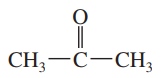
d.

Verified step by step guidance
1
Draw the Lewis structure for acetone (CH3COCH3). Start by arranging the carbon atoms in a chain with the central carbon double-bonded to an oxygen atom. Each carbon atom should have four bonds, and the oxygen should have two lone pairs.
Identify the bond dipole moments. The C=O bond is polar due to the difference in electronegativity between carbon and oxygen, with the dipole pointing towards the oxygen. The C-H bonds are less polar, with dipoles pointing towards the carbon.
Consider the molecular geometry. Acetone is a trigonal planar molecule around the central carbon, which affects how the dipoles add up.
Analyze the contribution of each dipole to the overall molecular dipole moment. The C=O bond has a significant dipole moment, while the dipoles from the C-H bonds on the methyl groups partially cancel each other out.
Estimate the overall dipole moment. Due to the strong dipole of the C=O bond and the geometry of the molecule, acetone is expected to have a moderate to large dipole moment.

Verified video answer for a similar problem:

This video solution was recommended by our tutors as helpful for the problem above.
Video duration:
3m
Was this helpful?

Key Concepts

Here are the essential concepts you must grasp in order to answer the question correctly.

Lewis Structure

The Lewis structure is a diagrammatic representation of a molecule showing how the valence electrons are distributed among the atoms. It helps in visualizing the bonding between atoms and any lone pairs of electrons. For acetone (CH3COCH3), the central carbon atom is double-bonded to oxygen and single-bonded to two methyl groups, with oxygen having two lone pairs.
Recommended video:
Guided course
04:12
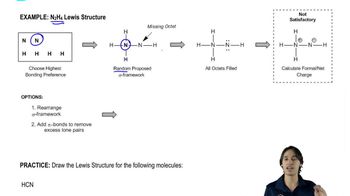
Drawing the Lewis Structure for N2H4.

Bond Dipole Moment

Bond dipole moments arise from differences in electronegativity between bonded atoms, creating a partial charge separation. In acetone, the C=O bond has a significant dipole moment due to oxygen's higher electronegativity compared to carbon, resulting in a partial negative charge on oxygen and a partial positive charge on carbon. This contributes to the overall molecular dipole moment.
Recommended video:
Guided course
01:46
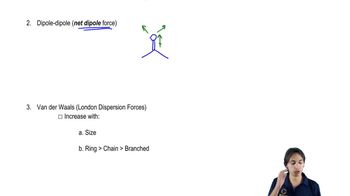
How dipole-dipole forces work.

Molecular Dipole Moment

The molecular dipole moment is the vector sum of all individual bond dipole moments in a molecule, indicating the overall polarity. In acetone, the dipole moment is primarily due to the polar C=O bond, as the symmetrical arrangement of the methyl groups cancels out their dipole contributions. Acetone has a moderate dipole moment, making it a polar molecule.
Recommended video:
Guided course
01:46
How dipole-dipole forces work.
Related Practice
Textbook Question

For each of the following compounds,

1. draw the Lewis structure.

2. show how the bond dipole moments (and those of any nonbonding pairs of electrons) contribute to the molecular dipole moment.

3. estimate whether the compound will have a large, small, or zero dipole moment.

e.

5
views
Textbook Question

Which of the following pure compounds can form hydrogen bonds? Which can form hydrogen bonds with water? Which ones do you expect to be soluble in water?

a. (CH3CH2)2NH

b. (CH3CH2)3N

c. CH3CH2CH2OH

d. (CH3CH2CH2)2OH

1
views
Textbook Question

The C≡N triple bond in acetonitrile has a dipole moment of about 3.6 D and a bond length of about 1.16 Å. Calculate the amount of charge separation in this bond. How important is the charge-separated resonance form in the structure of acetonitrile?

4
views
Textbook Question

Sulfur dioxide has a dipole moment of 1.60 D. Carbon dioxide has a dipole moment of zero, even though C―O bonds are more polar than S―O bonds. Explain this apparent contradiction.

2
views
Textbook Question

For each of the following compounds,

1. draw the Lewis structure.

2. show how the bond dipole moments (and those of any nonbonding pairs of electrons) contribute to the molecular dipole moment.

3. estimate whether the compound will have a large, small, or zero dipole moment.

a. CH3CH=NCH3

b. CH3CH2OH

c. CBr4

2
views
Textbook Question

Circle the functional groups in the following structures. State to which class (or classes) of compounds the structure belongs.

(g)

(h)

(i)

1
views