Ch. 2 - Acids and Bases; Functional Groups
Wade - Organic Chemistry 9th Edition
Wade9th EditionOrganic ChemistryISBN: 9780135213728Not the one you use?Change textbook
Chapter 2, Problem 26m,n,o

Draw a Lewis structure, and classify each of the following compounds:
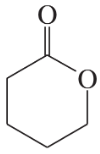
(m)
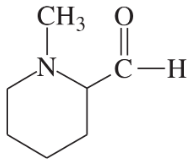
(n)
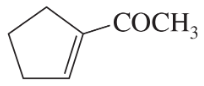
(o)

Verified step by step guidance
1
Identify the functional groups in each compound. For compound (m), recognize the presence of a lactone, which is a cyclic ester. For compound (n), identify the presence of an amide group, specifically an N-methyl amide. For compound (o), identify the presence of an enone, which is a conjugated ketone.
Draw the Lewis structure for compound (m). Start by drawing a six-membered ring with an oxygen atom double-bonded to a carbon (carbonyl group) and another oxygen atom single-bonded to the same carbon, forming an ester linkage.
Draw the Lewis structure for compound (n). Begin with a six-membered ring containing a nitrogen atom. Attach a methyl group (CH3) to the nitrogen and a carbonyl group (C=O) to the adjacent carbon, forming an amide linkage.
Draw the Lewis structure for compound (o). Start with a five-membered ring containing a double bond (indicating an alkene). Attach a carbonyl group (C=O) to the carbon adjacent to the double bond, and then attach a methyl group (CH3) to the carbonyl carbon, forming a ketone.
Classify each compound based on the identified functional groups. Compound (m) is classified as a lactone (cyclic ester), compound (n) as an N-methyl amide, and compound (o) as an enone (conjugated ketone).

Verified video answer for a similar problem:

This video solution was recommended by our tutors as helpful for the problem above.
Video duration:
8m
Was this helpful?

Key Concepts

Here are the essential concepts you must grasp in order to answer the question correctly.

Lewis Structures

Lewis structures are diagrams that represent the bonding between atoms in a molecule and the lone pairs of electrons that may exist. They help visualize the arrangement of electrons and the connectivity of atoms, which is crucial for understanding molecular geometry and reactivity. Drawing a Lewis structure involves determining the total number of valence electrons and distributing them to satisfy the octet rule for each atom.
Recommended video:
Guided course
04:12
Drawing the Lewis Structure for N2H4.

Functional Groups

Functional groups are specific groups of atoms within molecules that are responsible for the characteristic chemical reactions of those molecules. They determine the properties and reactivity of organic compounds. For example, the presence of a carbonyl group (C=O) indicates that the compound may be classified as an aldehyde or ketone, influencing its behavior in chemical reactions.
Recommended video:
Guided course
02:36
Identifying Functional Groups

Molecular Classification

Molecular classification involves categorizing compounds based on their structural features and functional groups. This classification helps predict the chemical behavior and reactivity of the compounds. For instance, compounds can be classified as aliphatic, aromatic, saturated, or unsaturated, depending on their structure, which is essential for understanding their properties and potential applications in organic chemistry.
Recommended video:
Guided course
08:41
Review of Molecular Orbitals