Ch.1 - Structure and Bonding
Wade - Organic Chemistry 9th Edition
Wade9th EditionOrganic ChemistryISBN: 9780135213728Not the one you use?Change textbook
Chapter 1, Problem 10d

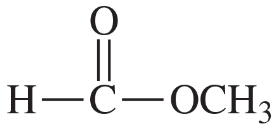
Use resonance structures to identify the areas of high and low electron density in the following compounds:
(d)

Verified step by step guidance
1
Identify the compound's structure and locate any pi bonds or lone pairs that can participate in resonance. These are typically found in conjugated systems or near electronegative atoms.
Draw the initial Lewis structure of the compound, ensuring all atoms have the correct number of valence electrons and formal charges are minimized.
Identify possible resonance contributors by moving electrons from pi bonds or lone pairs to adjacent atoms, ensuring that the octet rule is not violated for second-row elements.
Draw the resonance structures, showing the movement of electrons with arrows. Indicate the formal charges on atoms where necessary.
Analyze the resonance structures to determine areas of high electron density (where electrons are localized or delocalized) and low electron density (where positive charges or electron deficiency is present).

Verified video answer for a similar problem:

This video solution was recommended by our tutors as helpful for the problem above.
Video duration:
6m
Was this helpful?

Key Concepts

Here are the essential concepts you must grasp in order to answer the question correctly.

Resonance Structures

Resonance structures are different Lewis structures for a molecule that depict the same arrangement of atoms but differ in the distribution of electrons. They help illustrate the delocalization of electrons within a molecule, which can affect its stability and reactivity. Understanding resonance is crucial for identifying areas of electron density.
Recommended video:
Guided course
03:04
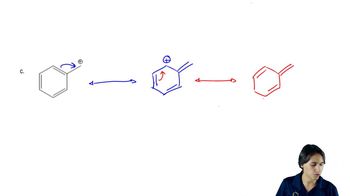
Drawing Resonance Structures

Electron Density

Electron density refers to the probability of finding electrons in a particular region of a molecule. Areas of high electron density are typically associated with negative charges or lone pairs, while areas of low electron density may be associated with positive charges or electron-deficient atoms. Resonance structures help visualize these variations in electron density.
Recommended video:
Guided course
03:54
The 18 and 16 Electron Rule

Lewis Structures

Lewis structures are diagrams that represent the bonding between atoms of a molecule and the lone pairs of electrons that may exist. They are essential for understanding resonance, as they provide a basis for drawing resonance structures by showing how electrons can be rearranged while maintaining the same atomic connectivity.
Recommended video:
Guided course
04:12
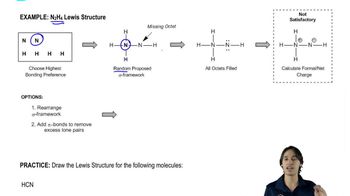
Drawing the Lewis Structure for N2H4.