Ch.1 - Structure and Bonding
Wade - Organic Chemistry 9th Edition
Wade9th EditionOrganic ChemistryISBN: 9780135213728Not the one you use?Change textbook
Chapter 1, Problem 54a,b,c

Predict the hybridization and geometry of the carbon and nitrogen atoms in the following molecules and ions. (Hint: Resonance.)
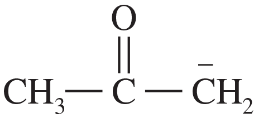
a.
b.
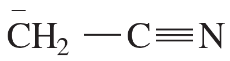
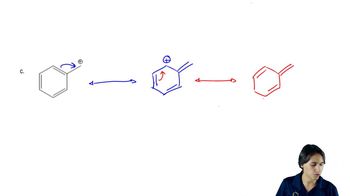
c.

Verified step by step guidance
1
For molecule (a) [CH3C(=O)CH2]-, identify the hybridization of each carbon atom. The first carbon (CH3) is sp3 hybridized due to its four single bonds. The second carbon (C=O) is sp2 hybridized because it forms a double bond with oxygen and a single bond with the adjacent carbon. The third carbon (CH2-) is sp3 hybridized as it has three single bonds and a lone pair, considering the negative charge.
For molecule (a), determine the geometry around each carbon atom. The first carbon (CH3) has a tetrahedral geometry due to its sp3 hybridization. The second carbon (C=O) has a trigonal planar geometry because of its sp2 hybridization. The third carbon (CH2-) also has a tetrahedral geometry due to its sp3 hybridization.
For molecule (b) [H2NCH=CHCH2]+, identify the hybridization of the nitrogen and carbon atoms. The nitrogen atom is sp3 hybridized as it forms three sigma bonds and has a lone pair. The first carbon (CH) is sp2 hybridized due to its double bond with the second carbon. The second carbon (CH) is also sp2 hybridized because of its double bond with the first carbon and a single bond with the third carbon. The third carbon (CH2)+ is sp2 hybridized due to the positive charge and its bonding.
For molecule (b), determine the geometry around each atom. The nitrogen atom has a trigonal pyramidal geometry due to its sp3 hybridization. The first and second carbons (CH=CH) have a trigonal planar geometry because of their sp2 hybridization. The third carbon (CH2)+ also has a trigonal planar geometry due to its sp2 hybridization.
For molecule (c) [CH2C≡N]-, identify the hybridization of the carbon and nitrogen atoms. The first carbon (CH2) is sp3 hybridized as it forms three sigma bonds and has a lone pair. The second carbon (C≡N) is sp hybridized due to its triple bond with nitrogen. The nitrogen atom is also sp hybridized because of its triple bond with carbon.

Verified video answer for a similar problem:

This video solution was recommended by our tutors as helpful for the problem above.
Video duration:
8m
Was this helpful?

Key Concepts

Here are the essential concepts you must grasp in order to answer the question correctly.

Hybridization

Hybridization is the concept of mixing atomic orbitals to form new hybrid orbitals that can accommodate the bonding requirements of atoms in a molecule. For carbon, common hybridizations include sp3, sp2, and sp, which correspond to different geometries: tetrahedral, trigonal planar, and linear, respectively. Understanding hybridization helps predict the shape and bond angles in molecules.
Recommended video:
Guided course
10:43
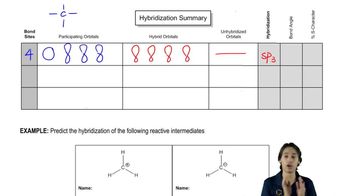
Using bond sites to predict hybridization

Molecular Geometry

Molecular geometry refers to the three-dimensional arrangement of atoms within a molecule. It is determined by the number of bonding pairs and lone pairs of electrons around the central atom, which influences the overall shape. Common geometries include linear, trigonal planar, tetrahedral, and trigonal bipyramidal, each with specific bond angles that can be predicted based on hybridization.
Recommended video:
Guided course
07:44
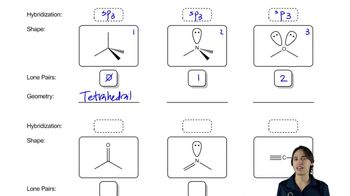
Molecular Geometry Explained.

Resonance

Resonance is a phenomenon in which a molecule can be represented by two or more valid Lewis structures, known as resonance structures. These structures differ only in the placement of electrons, not in the arrangement of atoms. Resonance helps explain the delocalization of electrons in molecules, affecting their stability, reactivity, and hybridization, which is crucial for accurately predicting molecular geometry.
Recommended video:
Guided course
03:04
Drawing Resonance Structures