Ch.1 - Structure and Bonding
Wade - Organic Chemistry 9th Edition
Wade9th EditionOrganic ChemistryISBN: 9780135213728Not the one you use?Change textbook
Chapter 1, Problem 44a

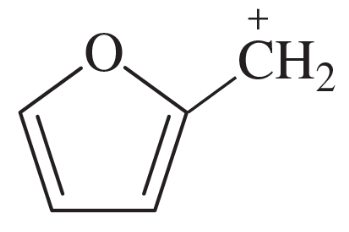
For each of these ions, draw the important resonance forms and predict which resonance form is likely to be the major contributor.
(a)

Verified step by step guidance
1
Identify the structure of the ion: The given ion is a five-membered ring with an oxygen atom and a positively charged CH2 group. This is a furan ring with a methylene group attached, carrying a positive charge.
Determine the possible resonance forms: In this structure, the positive charge can be delocalized through the pi system of the ring. Consider moving the pi electrons from the double bond adjacent to the positively charged carbon to form a new double bond between the oxygen and the carbon.
Draw the first resonance form: Move the pi electrons from the C=C double bond adjacent to the CH2+ group towards the CH2+ group, forming a new double bond between the CH2 and the adjacent carbon, and leaving a positive charge on the carbon that was part of the original double bond.
Draw the second resonance form: Move the pi electrons from the C=O double bond towards the oxygen atom, forming a lone pair on the oxygen and a positive charge on the carbon that was part of the C=O bond.
Predict the major contributor: The major resonance form is typically the one with the least charge separation and the most stable arrangement of charges. In this case, the resonance form where the positive charge is on the carbon adjacent to the oxygen (due to the electronegativity of oxygen) is likely to be the major contributor.

Verified video answer for a similar problem:

This video solution was recommended by our tutors as helpful for the problem above.
Video duration:
7m
Was this helpful?

Key Concepts

Here are the essential concepts you must grasp in order to answer the question correctly.

Resonance Structures

Resonance structures are different Lewis structures for a molecule that depict the same arrangement of atoms but differ in the distribution of electrons. They are used to represent delocalized electrons within certain molecules where the bonding cannot be expressed by a single Lewis structure. The true structure is a hybrid of all possible resonance forms, contributing to the molecule's stability.
Recommended video:
Guided course
03:04
Drawing Resonance Structures

Major and Minor Resonance Contributors

In resonance, not all structures contribute equally to the resonance hybrid. The major contributor is the resonance form with the lowest energy, typically having the most covalent bonds, the least charge separation, and negative charges on the most electronegative atoms. Minor contributors have higher energy due to less favorable charge distributions or incomplete octets.
Recommended video:
Guided course
03:04
Drawing Resonance Structures

Stability of Carbocations

Carbocations are positively charged carbon atoms, and their stability is influenced by factors such as hyperconjugation, resonance, and the inductive effect. Resonance can stabilize a carbocation if the positive charge can be delocalized over multiple atoms. In the given structure, the positive charge on the CH2 group can be stabilized by resonance with the adjacent oxygen atom, which can donate electron density through its lone pairs.
Recommended video:
Guided course
05:58
Determining Carbocation Stability