
For each of the following compounds and ions,
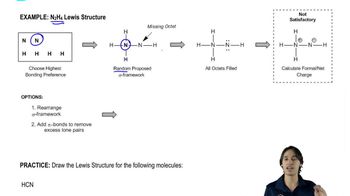
1. Draw a Lewis structure.
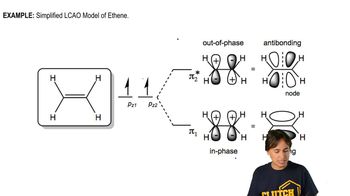
2. Show the kinds of orbitals that overlap to form each bond.
3. Give approximate bond angles around each atom except hydrogen.
d. CH3–CH=CH2
e. HC≡C–CHO
f. H2N–CH2–CN
Verified step by step guidance
For each of the following compounds and ions,
1. Draw a Lewis structure.
2. Show the kinds of orbitals that overlap to form each bond.
3. Give approximate bond angles around each atom except hydrogen.
d. CH3–CH=CH2
e. HC≡C–CHO
f. H2N–CH2–CN
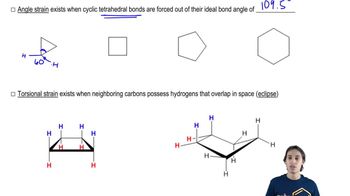
Cyclopropane (C3H6, a three-membered ring) is more reactive than most other cycloalkanes.
c. Suggest why cyclopropane is so reactive.
Cyclopropane (C3H6, a three-membered ring) is more reactive than most other cycloalkanes.
a. Draw a Lewis structure for cyclopropane.
b. Compare the bond angles of the carbon atoms in cyclopropane with those in an acyclic (noncyclic) alkane.
For each of the following compounds and ions,
1. Draw a Lewis structure.
2. Show the kinds of orbitals that overlap to form each bond.
3. Give approximate bond angles around each atom except hydrogen.
b. [CH2OH]+
For each of the following compounds and ions,
1. Draw a Lewis structure.
2. Show the kinds of orbitals that overlap to form each bond.
3. Give approximate bond angles around each atom except hydrogen.
c. CH2=N–CH3
If the carbon atom in CH2Cl2 were flat, there would be two stereoisomers. The carbon atom in CH2Cl2 is actually tetrahedral. Make a model of this compound, and determine whether there are any stereoisomers of CH2Cl2.