Ch. 9 - Alkenes II: Oxidation and Reduction
Mullins - Organic Chemistry: A Learner Centered Approach 1st Edition
Mullins1st EditionOrganic Chemistry: A Learner Centered ApproachISBN: 9780137566471Not the one you use?Change textbook
Chapter 8, Problem 13a

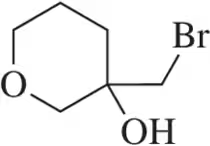
Suggest an alkene that could be used to make each of the following halohydrins.
(a) Chemical structure of a halohydrin featuring a six-membered ring with a bromine and hydroxyl group attached.

Verified step by step guidance
1
Identify the structure of the halohydrin provided in the problem. A halohydrin is an organic compound containing both a hydroxyl group (-OH) and a halogen atom (e.g., Cl, Br) on adjacent carbon atoms.
Determine the position of the hydroxyl group (-OH) and the halogen atom in the halohydrin. This will help you identify the carbon-carbon double bond (alkene) that could lead to this product.
Recall that halohydrins are typically formed through the reaction of an alkene with a halogen (e.g., Br2 or Cl2) in the presence of water. The reaction follows a regioselective and anti-addition mechanism.
Work backward to deduce the structure of the alkene. Remove the -OH group and the halogen atom from the halohydrin, and replace them with a double bond between the two adjacent carbon atoms.
Verify the structure of the proposed alkene by considering the regioselectivity and stereochemistry of the halohydrin formation reaction. Ensure that the alkene you suggest would lead to the given halohydrin under the reaction conditions.

Verified video answer for a similar problem:

This video solution was recommended by our tutors as helpful for the problem above.
Video duration:
4m
Was this helpful?

Key Concepts

Here are the essential concepts you must grasp in order to answer the question correctly.

Alkenes

Alkenes are hydrocarbons that contain at least one carbon-carbon double bond (C=C). They are unsaturated compounds, meaning they have fewer hydrogen atoms than alkanes. The presence of the double bond makes alkenes reactive, allowing them to undergo various addition reactions, which are crucial for synthesizing other organic compounds, including halohydrins.
Recommended video:
2:09
Alkene Metathesis Concept 1

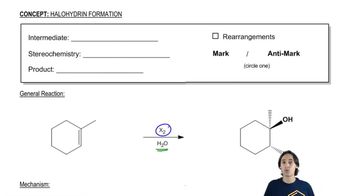
Halohydrin Formation

Halohydrins are compounds formed when alkenes react with halogens and water. This reaction typically involves the electrophilic addition of a halogen (like Br or Cl) followed by the nucleophilic attack of water, resulting in the formation of a halohydrin. Understanding the mechanism of this reaction is essential for predicting which alkene can yield a specific halohydrin.
Recommended video:
Guided course
01:44
General properties of halohydrin formation.

Regioselectivity

Regioselectivity refers to the preference of a chemical reaction to yield one structural isomer over others when multiple products are possible. In the context of halohydrin formation, the regioselectivity is influenced by the stability of the carbocation intermediate formed during the reaction. Recognizing how different alkenes can lead to different regioisomers is key to selecting the appropriate alkene for a desired halohydrin.
Recommended video:
Guided course
05:09
Heck Reaction